

Cost of IT Downtime – Why it Matters for SA Firms
When even a brief IT outage can cost a south-african business up to R724,000 per hour, ignoring the real scope of downtime is risky. For CIOs and IT managers at mid-sized engineering and financial firms, the true costs go beyond lost productivity and reach into financial losses and damaged reputation. Understanding the actual causes and misconceptions of IT downtime is critical if you want to protect your south-african operations and keep your systems resilient in the face of constant power instability and rising cyber threats.
Key Takeaways
| Point | Details |
|---|---|
| Understanding IT Downtime | IT downtime is a comprehensive breakdown of digital systems that can severely impact business operations, productivity, and financial performance. |
| Cascading Effects | A single technical failure can lead to widespread operational paralysis, affecting access to critical systems and resulting in significant financial loss. |
| Cybersecurity Threats | South African businesses face increasing cybersecurity risks that can render entire systems non-functional, necessitating robust protection strategies. |
| Risk Management Strategies | Developing comprehensive IT service continuity plans and proactive risk management frameworks is crucial to mitigate downtime and safeguard business integrity. |
Defining IT downtime and common misconceptions
IT downtime represents more than just a temporary technical interruption. It is a comprehensive breakdown of digital systems that directly impacts business productivity, financial performance, and operational capabilities. Many South African firms misunderstand the true scope and potential consequences of technological disruptions.
Contrary to popular belief, IT downtime is not simply about computers being offline. It encompasses a complex network of potential failures including server crashes, network connectivity issues, software malfunctions, cybersecurity breaches, and human error. Common IT problems in SMEs reveal that these disruptions can occur across multiple technological touchpoints, making prevention and rapid response critical.
Businesses often underestimate the cascading effects of technological interruptions. A single system failure can trigger widespread operational paralysis, preventing employees from accessing critical databases, communication platforms, customer relationship management systems, and financial records. The financial implications extend beyond immediate productivity loss, potentially damaging customer trust, compromising ongoing projects, and creating substantial recovery costs.
Pro tip: Develop a comprehensive IT service continuity plan that identifies potential system vulnerabilities and establishes clear recovery protocols before a disruption occurs.
Types of IT downtime affecting local businesses
South African businesses face a complex landscape of technological disruptions that can cripple operational efficiency. Businesses struggling with persistent IT challenges often encounter multiple types of downtime that extend far beyond simple system failures.
The primary categories of IT downtime impacting local enterprises include power-related interruptions, network connectivity issues, cybersecurity breaches, and infrastructure vulnerabilities. Prolonged load-shedding and power instability create unique challenges for South African businesses, causing unpredictable system shutdowns that can interrupt critical business processes and lead to substantial productivity losses.
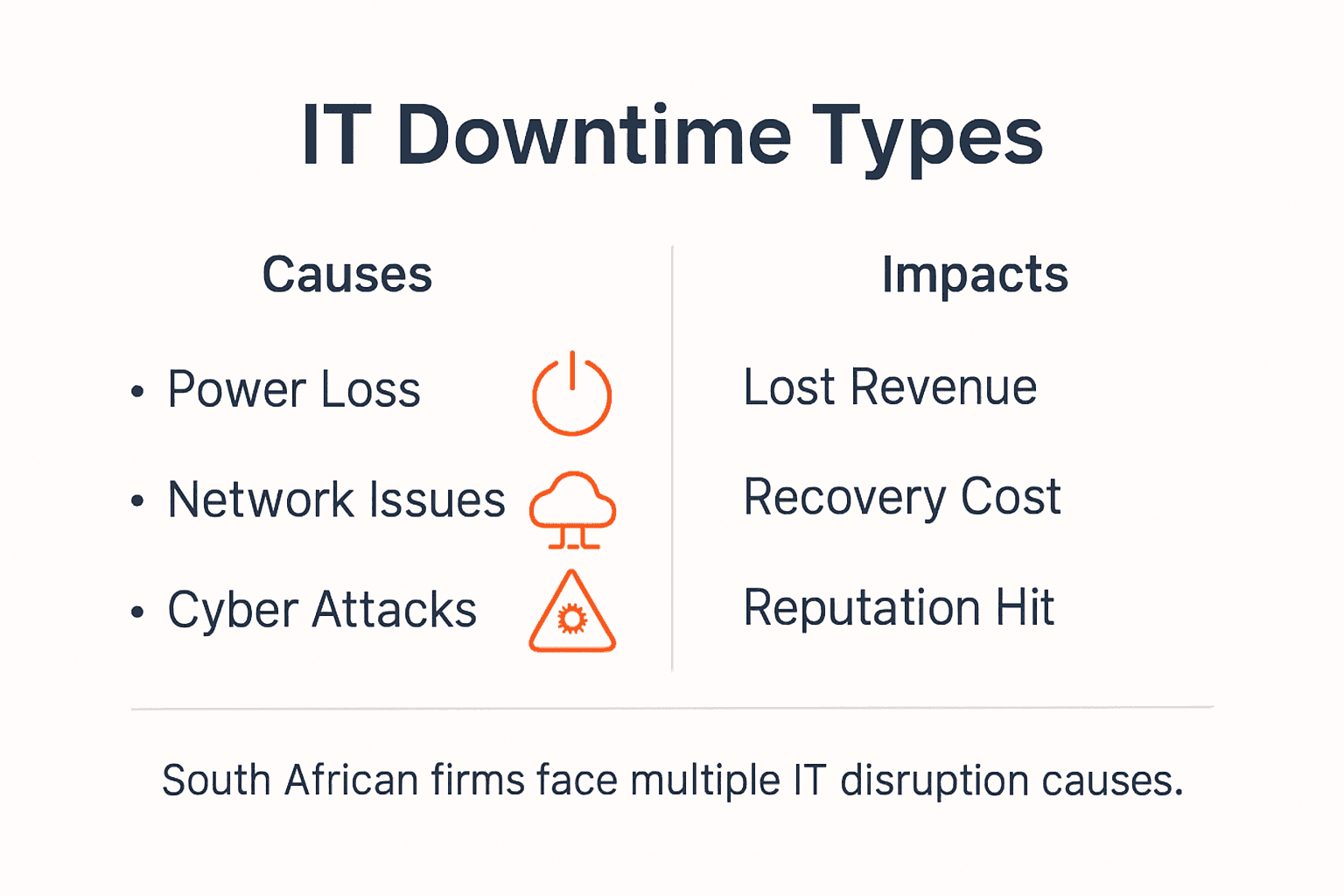
Cybersecurity-related downtime represents another significant threat, with ransomware attacks and data breaches potentially rendering entire technological ecosystems non-functional. Network failures stemming from over-reliance on single internet providers can disconnect businesses from essential communication platforms, customer management systems, and operational databases. Human error and infrastructure fragility further compound these risks, creating a multifaceted challenge for organisations seeking technological resilience.
Pro tip: Develop a multi-layered IT resilience strategy that includes redundant systems, backup power solutions, and comprehensive cybersecurity protocols to mitigate potential downtime risks.
Major causes: power, infrastructure, and cyber threats
South African businesses face a complex ecosystem of technological vulnerabilities that can systematically undermine operational stability. Sophisticated cyberattacks targeting critical infrastructure have become increasingly prevalent, presenting multifaceted risks across various sectors.
Power infrastructure represents the most immediate and persistent challenge for local organisations. Chronic load-shedding and electrical grid instability create unpredictable technology disruptions that force businesses to develop sophisticated contingency strategies. These power-related interruptions not only cause immediate system shutdowns but also potentially damage sensitive electronic equipment, leading to long-term operational complications.

Cybersecurity threats emerge as another critical vulnerability, with malicious actors increasingly targeting industrial control systems and network infrastructure. Understanding the evolving cyber threat landscape reveals that South African enterprises face sophisticated ransomware attacks, data breaches, and systematic infiltration attempts designed to exploit technological vulnerabilities. These cyber incidents can render entire technological ecosystems non-functional, creating substantial financial and reputational risks for organisations.
Here’s how major IT downtime causes differ in impact for South African businesses:
| Downtime Cause | Primary Business Impact | Typical Recovery Actions |
|---|---|---|
| Power interruptions | System shutdown, hardware risk | Generator backup, surge protection |
| Network connectivity loss | Communication breakdown | ISP redundancy, network failover |
| Cybersecurity breaches | Data loss, reputational damage | Forensic analysis, system restore |
| Infrastructure failures | Operational paralysis | Hardware upgrades, site audits |
Pro tip: Implement a comprehensive risk management framework that integrates robust power backup solutions, advanced cybersecurity protocols, and regular infrastructure vulnerability assessments to mitigate potential technological disruptions.
Financial impact: lost revenue, recovery, and reputation
Technological disruptions represent far more than simple operational inconveniences for South African businesses. Unplanned downtime costs can escalate rapidly, with organisations facing potential losses averaging R724,000 per hour, a staggering financial burden that can devastate smaller enterprises.
The financial implications extend beyond immediate revenue loss. Prolonged system failures trigger cascading economic consequences, including delayed project timelines, increased emergency IT expenditures, and substantial reputational damage. Clients and stakeholders quickly lose confidence in organisations demonstrating technological instability, potentially causing long-term business relationship deterioration and reduced market competitiveness.
Recovery expenses compound the financial strain, requiring significant investments in emergency IT support, system restoration, potential data reconstruction, and comprehensive forensic analysis. These unexpected costs can consume substantial portions of annual technology budgets, diverting critical resources from strategic growth initiatives and innovation investments. Moreover, the operational stress generated by persistent technological vulnerabilities can lead to decreased employee productivity and elevated organisational tension.
Pro tip: Develop a proactive financial risk management strategy that includes dedicated contingency funds for technological recovery and comprehensive cyber-insurance coverage to mitigate potential downtime-related financial losses.
Compliance risks and POPIA obligations during outages
South African organisations face complex legal challenges when managing personal information during technological disruptions. POPIA compliance requirements remain stringent even during unexpected IT system failures, mandating robust data protection protocols that persist regardless of operational challenges.
The Protection of Personal Information Act imposes critical obligations that do not suspend during downtime scenarios. Firms must maintain comprehensive data integrity, prevent unauthorised access, and ensure immediate reporting of potential breaches. Legal frameworks demand meticulous data governance with potential consequences including substantial financial penalties up to R10 million and potential criminal prosecution for non-compliance.
Specifically, organisations are required to conduct thorough impact assessments, implement emergency data protection mechanisms, and maintain confidentiality protocols even when primary technological systems experience interruptions. This necessitates advanced contingency planning that integrates legal compliance considerations directly into IT resilience strategies, ensuring personal information remains protected throughout potential system vulnerabilities.
Pro tip: Develop a comprehensive POPIA-compliant incident response plan that specifically addresses data protection protocols during technological disruptions, including clear reporting mechanisms and emergency data safeguarding procedures.
Prevention strategies: managed IT, backup, and resilience
Mitigating IT downtime requires a comprehensive, multi-layered approach that addresses technological vulnerabilities across different operational dimensions. Effective IT disaster recovery planning becomes crucial for South African organisations seeking to minimise potential disruption risks.
Managed IT services offer a proactive strategy for preventing downtime by providing continuous monitoring, rapid response capabilities, and sophisticated infrastructure management. These services integrate advanced threat detection, predictive maintenance, and robust backup systems that can quickly restore critical technological functions during unexpected interruptions. Key components include redundant network configurations, cloud-based data storage, real-time system monitoring, and automated failover mechanisms that ensure minimal operational impact.
Comprehensive backup strategies represent another critical prevention mechanism. Organisations must implement multi-tiered backup approaches that include local physical storage, geographically distributed cloud repositories, and encrypted data replication systems. These strategies should encompass not just data preservation, but also rapid recovery protocols that enable swift system restoration and minimal business interruption.
Pro tip: Develop a comprehensive technological resilience framework that combines managed IT services, multi-layered backup strategies, and regular system vulnerability assessments to create a holistic approach to preventing and mitigating potential downtime incidents.
Summary of effective IT downtime prevention strategies for local enterprises:
| Strategy | Key Features | Business Benefit |
|---|---|---|
| Managed IT services | 24/7 monitoring, rapid response | Early issue detection and control |
| Backup & data recovery | Cloud storage, regular encryption | Fast restoration after incidents |
| Infrastructure resilience | Redundant hardware, routine audits | Sustained operations under stress |
| Cybersecurity protocols | Threat assessment, automated updates | Lower risk of data breaches |
Protect Your Business From Costly IT Downtime Today
IT downtime is a critical challenge for South African firms, especially those in engineering and financial sectors with 20 to 300 staff. The article highlights how unplanned interruptions can cause severe financial losses, reputational damage, and compliance risks under POPIA. Understanding terms like power interruptions, cybersecurity breaches, and backup strategies is essential to preventing these dangerous impacts.
At Techtron, we specialise in managed IT services designed to reduce your risk of downtime through proactive monitoring, robust cybersecurity, and comprehensive disaster recovery solutions. Our tailored approach ensures your business stays operational during power disruptions or cyber threats while maintaining legal compliance. Discover how partnering with us can protect your revenue, reputation, and data integrity by visiting Techtron Cybersecurity and exploring our Backup and Disaster Recovery services.
Don’t wait for a costly outage to disrupt your business. Act now to safeguard your operations with expert support that fits your unique needs. Visit https://techtron.co.za to learn more and start building your IT resilience strategy today.
Frequently Asked Questions
What is the cost of IT downtime for businesses?
The cost of IT downtime can be significant, averaging around R724,000 per hour for South African businesses. This includes lost revenue, increased recovery expenses, and reputational damage that can affect customer trust and business relationships.
What are the common causes of IT downtime?
Common causes of IT downtime include power-related interruptions, network connectivity issues, cybersecurity breaches, and infrastructure vulnerabilities. Each of these factors can have serious implications for an organization’s operational efficiency.
How can businesses prevent IT downtime?
Businesses can prevent IT downtime by implementing managed IT services, establishing robust backup strategies, and creating infrastructure resilience plans. Regular system monitoring, data encryption, and maintaining redundant systems are key strategies for minimizing risks.
What is the financial impact of prolonged IT downtime?
Prolonged IT downtime leads to cascading financial impacts such as delayed project timelines, increased emergency IT costs, and diminished customer confidence. These effects can ultimately hinder an organization’s market competitiveness and strategic growth initiatives.