

Managed IT services explained: boost security and efficiency
Most mid-sized professional service firms in South Africa assume that keeping IT in-house gives them more control and better security. The reality is often the opposite. Internal IT teams are stretched thin, reactive by nature, and rarely equipped to handle the speed and sophistication of modern cyber threats. Research consistently shows that outsourcing to a specialist provider delivers stronger security outcomes and measurable efficiency gains. This guide breaks down exactly what managed IT services are, how they work across their full lifecycle, what the numbers say about return on investment, and why South African firms are adopting this model faster than ever.
Key Takeaways
| Point | Details |
|---|---|
| MSPs enhance security | Outsourcing IT to managed providers delivers better cybersecurity and compliance than relying solely on in-house teams. |
| Clear ROI track record | Managed IT services commonly generate 20-30% ROI and greatly reduce downtime and breach risk for mid-sized firms. |
| SLA and partnerships matter | The real value comes from careful SLA structures and collaborative, ongoing engagement with your provider. |
| Local market growth | South African adoption is accelerating, fueled by rising cyber risks and compliance pressures. |
What are managed IT services?
The misconception around in-house IT leads many firms to miss out on real, tangible benefits. So let’s start with a clear definition before going any further.
Managed IT services involve outsourcing your ongoing IT operations to a specialist company called a Managed Service Provider, or MSP. The engagement is governed by a Service Level Agreement, commonly called an SLA. As one industry source explains, managed IT services involve outsourcing ongoing IT operations to an MSP under an SLA that defines scope, uptime, response times, and responsibilities.
This is not simply hiring an external technician to fix things when they break. A proper MSP operates proactively, monitoring your systems around the clock, patching vulnerabilities before they become incidents, and managing your entire IT environment as a continuous service rather than a series of one-off jobs.

When you compare the IT support types available to professional service firms, managed services sit at the top of the maturity curve. Break-fix support reacts to problems. Managed services prevent them.
Key features of a robust managed IT service include:
- 24/7 remote monitoring and management of servers, endpoints, and networks
- A dedicated helpdesk with defined response time tiers
- Proactive patch management and vulnerability scanning
- Cybersecurity services including threat detection and incident response
- Asset inventory and lifecycle management
- Regular reporting and strategic IT planning
- Clearly documented service level agreements covering uptime and resolution targets
Two common myths deserve direct attention. First, firms worry about losing control of their IT environment. In practice, a well-structured MSP engagement gives you more visibility through dashboards, reporting, and regular reviews, not less. Second, firms fear hidden costs. A reputable MSP prices on a predictable per-user or per-device monthly model, which actually makes IT budgeting far more accurate than the unpredictable costs of in-house support.
“A managed service is not an outsourcing arrangement where you hand over responsibility and hope for the best. It is a structured partnership with defined accountability at every layer.”
Understanding this distinction is what separates firms that get real value from managed IT from those that remain frustrated by the model.
The operational lifecycle of managed IT
Now that the basics are clear, it’s important to see how managed IT services function from the moment you sign an agreement to years down the line.
A well-run managed IT engagement follows four lifecycle phases that build on each other:
- Discovery and baselining: The MSP conducts a full asset inventory, assesses your current security posture, identifies gaps, and documents your environment. This phase sets the performance baseline everything else is measured against.
- Onboarding: Remote Monitoring and Management (RMM) and Professional Services Automation (PSA) tools are deployed across your environment. Security frameworks such as the NIST Cybersecurity Framework are used to align your infrastructure to best practices from day one.
- Ongoing operations: This is where the day-to-day value is delivered. Your MSP monitors systems 24/7, manages incidents using a tiered response model, handles patching, and supports your staff through the helpdesk.
- Review and optimisation: Quarterly Business Reviews (QBRs) are held to assess performance against SLA targets, review incident trends, and build a forward-looking IT roadmap. This phase is where the operational lifecycle transitions from reactive management to genuine strategic partnership.
The tiered incident response model used in phase three is worth understanding. Priority 1 (P1) incidents are critical outages affecting the whole business and typically require response within 15 to 30 minutes. Priority 2 (P2) covers significant issues affecting multiple users, with a one to four hour response window. Priority 3 (P3) handles low-impact requests and general support tickets, usually resolved within one business day.
| Phase | In-house approach | Managed IT approach |
|—|—|—||
| Discovery | Often skipped or informal | Structured audit with documented baseline |
| Onboarding | Ad hoc tool deployment | Standardised RMM/PSA rollout |
| Operations | Reactive, business-hours only | Proactive, 24/7 monitoring |
| Review | Rarely formalised | Scheduled QBRs with measurable KPIs |
Pro Tip: Use your QBRs to push your MSP for a forward-looking technology roadmap, not just a backward-looking incident report. The best MSPs will help you plan infrastructure upgrades, licensing changes, and security improvements 12 to 18 months ahead.
ROI and business impact: what the numbers show
Understanding the process is important, but quantifying the business value makes the case undeniable. Here is the data every South African decision-maker should see.
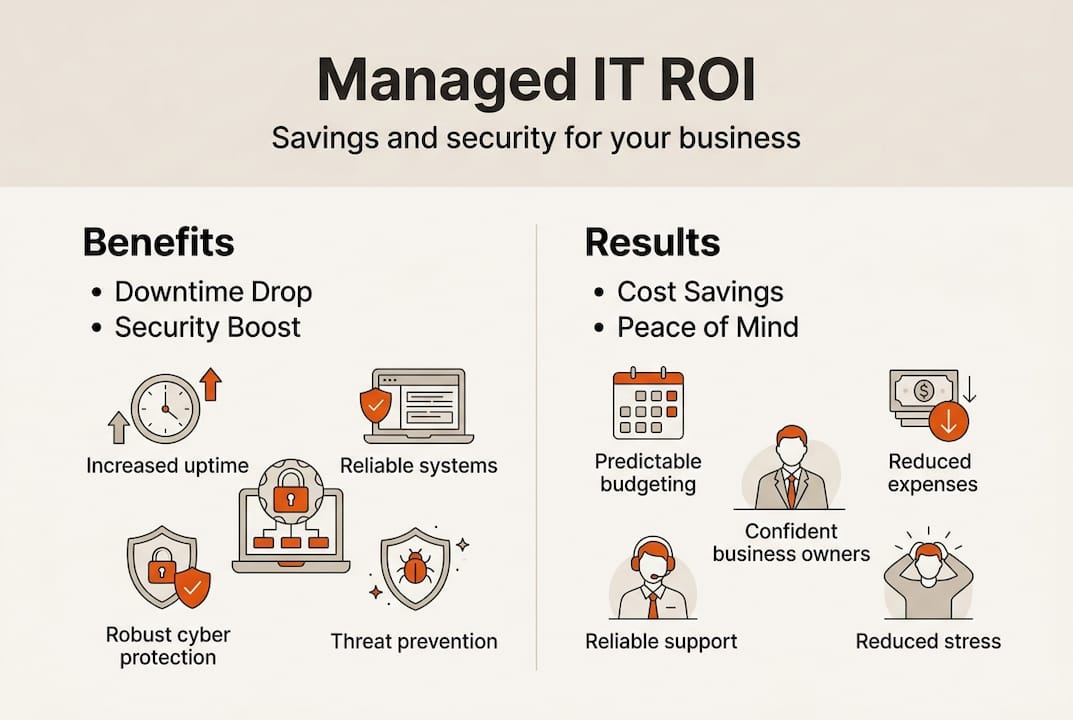
Industry ROI benchmarks are striking: firms typically see a 20 to 30% return in the first year alone (Gartner), downtime reduction worth more than $70,000 annually for mid-sized businesses, breach avoidance savings exceeding $2 million given that the average breach now costs $4.45 million (IBM), productivity gains of 45 to 65%, and helpdesk ticket volumes dropping by 40 to 60% (HDI).
| Metric | Typical in-house result | Managed IT result |
|---|---|---|
| Annual downtime cost | $100k+ | Reduced by $70k+ |
| Breach risk exposure | High, unstructured | Significantly mitigated |
| IT staff productivity | 60-70% on reactive tasks | Freed for strategic work |
| Helpdesk resolution time | Variable | SLA-governed, consistent |
| Year-one ROI | Difficult to measure | 20-30% (Gartner benchmark) |
The financial case is clear. But the non-financial benefits are equally important for IT cost benchmarks in high-compliance sectors like engineering and financial services:
- Strategic focus: Your internal team stops firefighting and starts contributing to business growth
- Compliance readiness: MSPs maintain frameworks aligned to POPIA, ISO 27001, and sector-specific requirements
- Staff enablement: Faster helpdesk resolution means less frustration and higher productivity across the business
- Vendor management: Your MSP handles Microsoft, network, and hardware vendors on your behalf
- Scalability: Adding or removing users is simple and cost-effective under a per-user model
The ROI formula most used in the industry is straightforward: take the total value of avoided costs (downtime, breaches, inefficiency) and subtract the annual managed IT investment. For most mid-sized South African firms, the math works strongly in favour of managed services within the first 12 months.
Why managed IT services matter for South African firms
These results are even more relevant when we consider South Africa’s unique IT challenges and opportunities.
The South African IT services market is growing fast. Market projections show the sector expanding from USD 14.73 billion in 2025 to USD 26.99 billion by 2030, a compound annual growth rate of 12.87%. Managed Security Services specifically are growing at 14.2% CAGR, and South Africa holds a 23.5% share of the African cybersecurity market, with Managed Security Services accounting for 32.4% of that spend.
This growth is not accidental. Several local pressures are accelerating adoption:
- Load shedding: Power instability creates infrastructure risk that MSPs manage through UPS monitoring, cloud failover, and backup systems
- Cybercrime exposure: South Africa ranks among the most targeted countries globally for ransomware and business email compromise
- POPIA compliance: The Protection of Personal Information Act places legal obligations on firms to protect client data, and MSPs help enforce this
- Skills shortage: Qualified IT professionals are scarce and expensive, making outsourcing a practical talent strategy
- Remote and hybrid work: Distributed teams require secure, always-on IT infrastructure that in-house teams struggle to maintain alone
“South Africa’s managed IT market is not growing because it’s trendy. It’s growing because local firms are facing threats and operational pressures that internal teams simply cannot absorb alone.”
Exploring the local cybersecurity landscape makes it clear that the threat environment here is serious and specific. Understanding why local IT partners outperform global generalist providers is equally important for firms in this market.
Our take: what most firms miss about managed IT
While the evidence is compelling, there is a perspective every decision-maker should keep front of mind before signing with an MSP.
Most firms focus on the monthly cost when evaluating managed IT. That is the wrong lens. The real question is what a P1 incident at 2am on a Friday costs your business in lost revenue, client trust, and staff hours. Your SLA essentials are not legal boilerplate. They are your financial protection. A poorly written SLA with vague response time language will fail you exactly when you need it most.
QBRs are equally undervalued. Most firms treat them as a formality. The firms getting the most from their MSP use QBRs to hold the provider accountable to specific metrics and to co-create a 12-month technology roadmap. That is where the strategic value of managed IT separates itself from simple outsourcing.
Our honest advice: measure ROI beyond cost savings. Track downtime incidents, breach near-misses, staff satisfaction with IT, and compliance audit outcomes. Those numbers tell the real story of whether your MSP partnership is working.
Find the right managed IT partner for your business
If you are ready to move beyond reactive IT and build a resilient, secure technology environment, Techtron offers the expertise and local knowledge your firm needs. Explore our approach to infrastructure management South Africa to see how we structure engagements for mid-sized professional service firms. Our cybersecurity services are built for the South African threat landscape, and our commitment to IT documentation best practices ensures your environment is always audit-ready. Reach out to start a conversation about what the right managed IT partnership looks like for your business.
Frequently asked questions
What is a managed service provider (MSP)?
An MSP is a company that remotely manages your IT infrastructure and end-user systems under a subscription model, governed by a Service Level Agreement that defines scope, uptime, and responsibilities. Think of it as having an enterprise-grade IT department without the overhead of building one internally.
How do SLAs protect my business?
SLAs set enforceable expectations for response times, resolution targets, and accountability, which means your MSP is contractually obligated to perform. Without a strong SLA, you have no recourse when response times and uptime commitments are missed.
What ROI can mid-sized South African firms expect from managed IT?
Benchmarks show a 20 to 30% ROI in year one, alongside downtime reduction worth over $70,000 annually and significant reduction in breach exposure. The financial case strengthens further when you factor in compliance and productivity gains.
How does managed IT help with cybersecurity?
MSPs provide continuous threat monitoring, rapid incident response, and enforce security best practices across your environment. This matters enormously in South Africa, where the country holds a 23.5% share of Africa’s cybersecurity market and faces some of the continent’s highest attack volumes.
Is managed IT only for large businesses?
No. Mid-sized firms with 20 to 300 staff often gain the most from managed IT because they face enterprise-level threats without enterprise-level internal resources. The 12.87% CAGR growth in South Africa’s IT services market reflects strong adoption across businesses of all sizes.