

How to choose an IT provider for your business in 2026
TL;DR:
- Choosing an IT provider requires assessing security capabilities, industry experience, and contract flexibility through a structured evaluation process.
- Prioritizing Zero Trust Architecture, detailed SLAs with penalties, and annual security reassessments ensures long-term service reliability and security compliance.
Choosing an IT provider is the process of selecting a managed service partner whose security capabilities, service scope, and industry expertise align with your firm’s operational and compliance requirements. For mid-sized professional services companies in South Africa, this decision carries real weight. A poorly chosen provider creates security gaps, service disruptions, and contract lock-in that cost far more than the monthly retainer. The criteria covered here, including Zero Trust Architecture, SLA structure, and NIST CSF-aligned governance, give IT decision-makers a structured path to a partnership that holds up over time.
What criteria should you use when selecting an IT provider?
The most common mistake in selecting an IT provider is treating it like a procurement exercise rather than a strategic evaluation. Price and speed of response are the two factors that dominate most shortlists. Both are the wrong starting points.

Security capabilities come first. A provider working with professional services firms, whether engineering consultancies, law firms, or financial advisors, must demonstrate alignment with modern security frameworks. Zero Trust Architecture is now the benchmark standard, not a premium add-on. It means no user, device, or system is trusted by default, even inside your network. For a firm handling client financial data or confidential project files, this posture is non-negotiable. Ask providers directly how they enforce least-privilege access and whether they support hybrid workforce environments with cloud-distributed resources.
Industry-specific experience matters more than general IT competence. A provider that has managed IT for a 50-person engineering firm understands the compliance requirements, software dependencies, and workflow patterns that a generalist provider will spend months learning at your expense. Ask for case studies from firms of similar size and sector. If they cannot produce two or three, they are not the right fit.
Service breadth determines whether you need one provider or three. The right provider covers helpdesk support, proactive monitoring, backup and disaster recovery, and managed security under one agreement. Fragmented providers create accountability gaps. When a security incident occurs, each vendor points at the other. A single managed service provider with end-to-end accountability removes that risk entirely.
SLAs with teeth are non-negotiable. Response time commitments mean nothing without penalties for failure. A well-structured SLA defines response times by severity, specifies resolution targets, and includes financial consequences for repeated breaches. An SLA that says “we aim to respond within four hours” is a marketing statement, not a contract term.
Pro Tip: Request a sample SLA document before signing anything. If the provider hesitates or says it is customised later, that is a red flag. Reputable providers have standard SLA templates they share freely during evaluation.
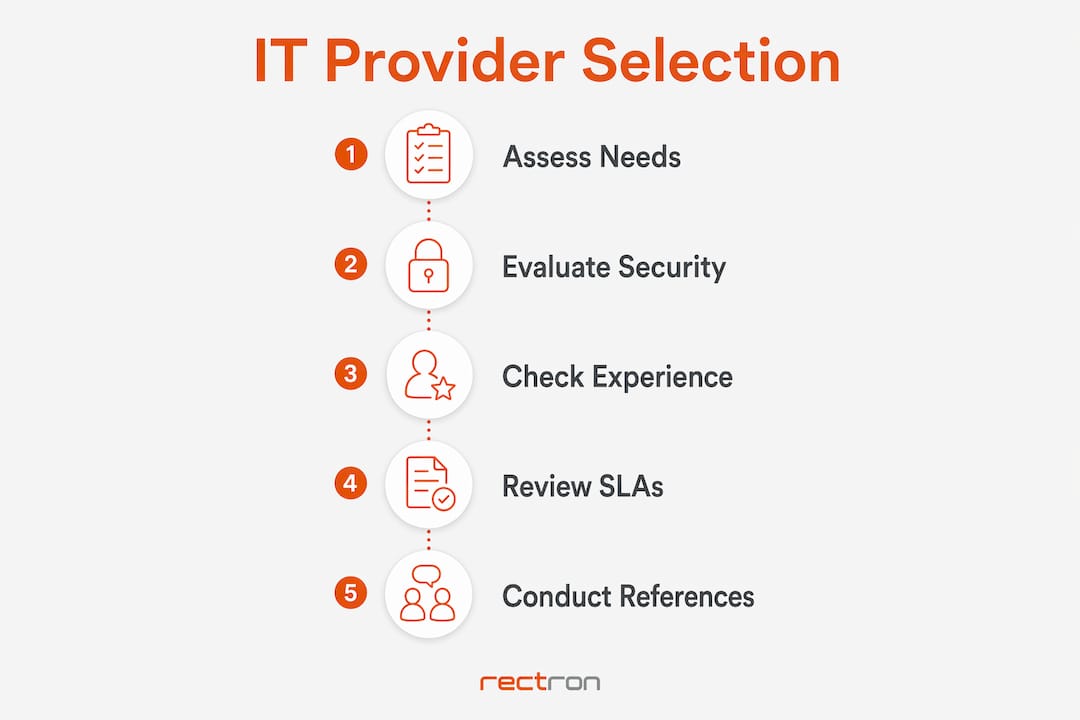
Reference checks close the loop. Contact two or three current clients in similar industries and ask specific questions: How did the provider handle the last major outage? Did they communicate proactively or reactively? Would you renew the contract? Vague praise tells you nothing. Specific incident stories tell you everything.
How do you run a rigorous IT provider evaluation process?
A structured MSP evaluation typically spans six to eight weeks and involves multiple providers, standardised scoring, and contract negotiation. That timeline exists for good reason. Rushing it produces the same outcome as skipping it entirely.
Follow this sequence to evaluate providers objectively:
-
Scope your internal requirements before contacting any vendor. Document your current infrastructure, headcount, software stack, compliance obligations, and pain points. A firm running Microsoft 365 and Azure with 80 staff has different needs than one running on-premise servers with 25 users. Without this baseline, you cannot evaluate proposals on equal terms.
-
Build a standardised RFP and send it to three to five qualified providers. Standardised RFP questions should include client-to-technician ratio, after-hours response process, backup and restore procedures, compliance experience, and exit processes. Written answers eliminate the ambiguity of sales calls and give you comparable data across providers.
-
Score proposals against fixed criteria. Use a weighted scoring table that covers SLA terms, security capabilities, industry experience, pricing transparency, and contract flexibility. Here is a practical scoring framework:
| Evaluation criterion | Weighting | What to assess |
|---|---|---|
| Security capabilities | 30% | Zero Trust, ICAM, incident response process |
| SLA terms and penalties | 25% | Response times, resolution targets, breach consequences |
| Industry experience | 20% | Sector-specific case studies, compliance knowledge |
| Contract flexibility | 15% | Exit clauses, notice periods, auto-renewal terms |
| Pricing transparency | 10% | Fixed vs. variable costs, scope creep protections |
-
Conduct structured reference checks. Contact references provided by each shortlisted provider and ask the same questions to each. Focus on how the provider handled failures, not just successes. A provider who managed a ransomware incident well is more valuable than one who has never been tested.
-
Negotiate contract terms before committing. Most bad IT selections result from prioritising the fastest or cheapest response over a structured process. The evaluation stage is where you have the most leverage. Use it.
Pro Tip: Never make a final decision based on a sales presentation alone. Require a written technical proposal and at least one reference call with a client in a comparable industry before scoring any provider.
What contract terms protect you in an IT provider agreement?
The contract is where good intentions become enforceable commitments. Many professional services firms sign agreements that look reasonable on the surface but contain terms that create long-term exposure.
Watch for these specific contract risks:
- Auto-renewal clauses with short opt-out windows. Some contracts auto-renew for 12 months if you do not cancel within 30 days of the anniversary. Exit terms should allow termination without penalty after repeated SLA failures, with opt-out notice periods that give you adequate time to transition.
- Absence of security obligations. The contract must specify the provider’s security responsibilities, including incident notification timelines, data handling procedures, and equipment disposal policies. A provider who resists including these terms is telling you something important about their security culture.
- Vague scope definitions. “IT support” means different things to different providers. Define exactly what is included: helpdesk hours, monitoring scope, backup frequency, patch management, and what triggers an out-of-scope charge.
“Security governance is not a one-time contract inclusion. It requires continuous monitoring and reassessment of providers to mitigate risks as your business and the threat environment evolve.”
Annual reassessment is a best practice aligned with NIST CSF Control 15. This means reviewing your provider’s performance, security posture, and service evolution every 12 months. Treat provider security posture as a system to be evaluated periodically using certifications such as SOC 2 and rigorous questionnaires, not just a sales claim. When ending a provider relationship, require a formal decommissioning process that includes credential revocation, data return, and access termination documentation.
How do you evaluate a provider’s cybersecurity capabilities?
Cybersecurity is the area where the gap between what providers claim and what they deliver is widest. Every provider will tell you they take security seriously. The question is how to verify it.
Start with framework alignment. Providers demonstrating adherence to ITIL, SOC 2, or PCI AoC tend to have proven processes for threat response and data protection. These certifications are not guarantees, but they indicate that a provider has invested in structured security management. Ask for current certificates, not just claims.
Ask specific questions about identity and access management. NIST guidance on Zero Trust identifies identity and credential access management (ICAM) as a core component of secure IT delivery. A provider should be able to explain how they enforce multi-factor authentication, manage privileged access, and handle access revocation when staff leave your firm.
Use this comparison to separate providers by security maturity:
| Security capability | Basic provider | Security-mature provider |
|---|---|---|
| Access management | Password policies only | MFA, ICAM, least-privilege enforcement |
| Threat detection | Reactive, ticket-based | Continual monitoring with AI-enabled detection |
| Incident response | Ad hoc, verbal process | Documented response plan with defined notification timelines |
| Compliance support | General awareness | Sector-specific compliance experience and audit support |
| Security reviews | On request | Scheduled quarterly and annual assessments |
Continual threat monitoring is the dividing line between providers who manage IT and providers who protect it. AI-enabled detection tools identify anomalous behaviour before it becomes an incident. For a professional services firm handling sensitive client data, the difference between reactive and proactive security is the difference between a contained alert and a reportable breach.
Ask every shortlisted provider to describe their last three security incidents and how they were resolved. The quality of that answer tells you more about their security culture than any certification document.
Key takeaways
Choosing the right IT provider requires a structured evaluation process that scores security capabilities, SLA terms, industry experience, and contract flexibility before any commitment is made.
| Point | Details |
|---|---|
| Security is the primary criterion | Require Zero Trust alignment, ICAM capabilities, and documented incident response before shortlisting. |
| Use a standardised RFP process | Send identical written questions to three to five providers and score responses against fixed criteria. |
| Contracts must include exit terms | Require SLA breach exit clauses, security obligations, and opt-out notice periods under 30 days. |
| Reassess providers annually | Align provider reviews with NIST CSF Control 15 to monitor security posture and service evolution. |
| Reference checks are non-negotiable | Ask current clients about incident handling, not just general satisfaction, to validate provider claims. |
What I have learned from watching firms get this wrong
Steven here. After years of working with mid-sized professional services firms across South Africa, the pattern I see most often is this: a firm chooses a provider based on a confident sales presentation and a competitive monthly rate, then spends the next 18 months managing the consequences.
The firms that get this right share one habit. They slow down the decision. They build a scoring matrix before they speak to a single vendor. They send written RFPs and refuse to shortlist anyone who will not answer in writing. They call references and ask uncomfortable questions. That discipline is not bureaucracy. It is the only reliable way to separate providers who can deliver from those who can sell.
The security piece is where I see the most dangerous shortcuts. A firm handling client financial data or confidential engineering designs cannot afford a provider whose security posture is “we have antivirus and a firewall.” Zero Trust is not a luxury framework for enterprise firms. It is the minimum standard for any professional services business operating in a hybrid or cloud environment today.
The other mistake I see repeatedly is signing contracts without exit flexibility. A 36-month agreement with a 60-day auto-renewal window and no SLA breach exit clause is a trap. Providers who resist exit terms are telling you they expect you to be unhappy. Negotiate hard on this before you sign anything.
My honest recommendation: treat this as a strategic IT partnership decision, not a vendor selection. The right provider grows with your firm, adapts to your compliance requirements, and proactively flags risks before they become incidents. That relationship is worth the extra four weeks it takes to evaluate properly.
— Steven
How Techtron supports professional services firms
Techtron works with engineering, financial, and professional services firms across South Africa that need more than reactive IT support. The approach covers managed IT services built around proactive security, Microsoft 365 and Azure management, backup and disaster recovery, and cybersecurity frameworks aligned with modern standards including Zero Trust. For firms with 20 to 300 staff, Techtron provides the structured, accountable IT partnership that this article describes. If you are currently evaluating providers or reassessing an existing agreement, explore Techtron’s IT solutions for professional services to see how the evaluation criteria in this guide translate into a real service offering.
FAQ
What are the most important criteria for choosing IT service providers?
Security capabilities, SLA terms with penalties, industry-specific experience, and contract flexibility are the four primary criteria. Providers should demonstrate Zero Trust alignment and hold certifications such as SOC 2 before being shortlisted.
How many IT providers should you include in an RFP process?
Send your RFP to three to five qualified providers. This gives you enough comparable data to score objectively without creating an unmanageable evaluation workload.
What questions should you ask IT providers during evaluation?
Ask about client-to-technician ratios, after-hours response processes, backup and restore procedures, compliance experience, and exit processes. Written answers to standardised questions eliminate sales-driven ambiguity and allow direct comparison.
How often should you reassess your IT provider?
Annual reassessment aligned with NIST CSF Control 15 is the recommended minimum. Reviews should cover security posture, SLA performance, compliance status, and whether the provider’s capabilities still match your business requirements.
What contract terms reduce risk when picking IT services?
Require exit clauses triggered by repeated SLA failures, opt-out notice periods under 30 days, explicit security obligations, and no long auto-renewal windows. Clear SLA definitions with financial penalties for breach are the most important protective terms in any IT provider agreement.