

Managed service provider: the mid-sized business IT guide
TL;DR:
- Managed service providers remotely handle a company’s IT systems, offering proactive support and cybersecurity. They use ITSM frameworks like ServiceNow to deliver consistent, measurable outcomes. Selecting an MSP requires evaluating expertise, scalability, transparency, and clear security responsibilities for long-term value.
A managed service provider (MSP) is a third-party company that remotely manages a business’s IT infrastructure under a defined service agreement, replacing unpredictable break-fix costs with structured, proactive support. For mid-sized South African companies in engineering, finance, and professional services, this model directly addresses the gap between growing IT complexity and limited internal IT capacity. Tools like ServiceNow and Jira Service Management sit at the core of how leading MSPs track, prioritise, and resolve issues. The shift from reactive IT support to a proactive MSP model is one of the most consequential technology decisions a business executive can make.
How does a managed service provider improve IT management and cybersecurity?
The core advantage of outsourced IT solutions is the shift from reactive to proactive management. Proactive MSP models include 24/7 network monitoring, patch management, and threat detection, all governed by service level agreements (SLAs) that define response times and uptime guarantees. This replaces the traditional break-fix model, where businesses only called for help after something failed.

Cybersecurity is where the proactive model delivers the clearest return. MSPs deploy AI-powered threat detection tools that identify anomalies before they become incidents. Downtime prevention through predictive maintenance keeps systems running and reduces the financial exposure that comes with unplanned outages.
Key security and management capabilities a quality MSP delivers include:
- 24/7 monitoring: Continuous oversight of networks, endpoints, and servers to catch threats in real time.
- Patch management: Regular updates applied across all devices to close known vulnerabilities before attackers exploit them.
- Incident response: Defined escalation paths and response protocols that reduce the time between detection and resolution.
- Backup and disaster recovery: Automated backups with tested recovery procedures to protect business continuity.
- Compliance support: Assistance with regulatory requirements relevant to South African industries, including POPIA.
Pro Tip: Cybersecurity responsibility is shared. Even with a strong MSP in place, your staff remain the primary target for phishing attacks. Defining roles clearly in your contract prevents disputes when an incident occurs.
What pricing models do managed service providers use?
MSP pricing follows three main structures, and choosing the wrong one for your business size creates either overspending or gaps in coverage. AI-driven pricing models can reduce costs by up to 70% compared to traditional staffing models. That figure reflects the efficiency gains from automation, not a reduction in service quality.
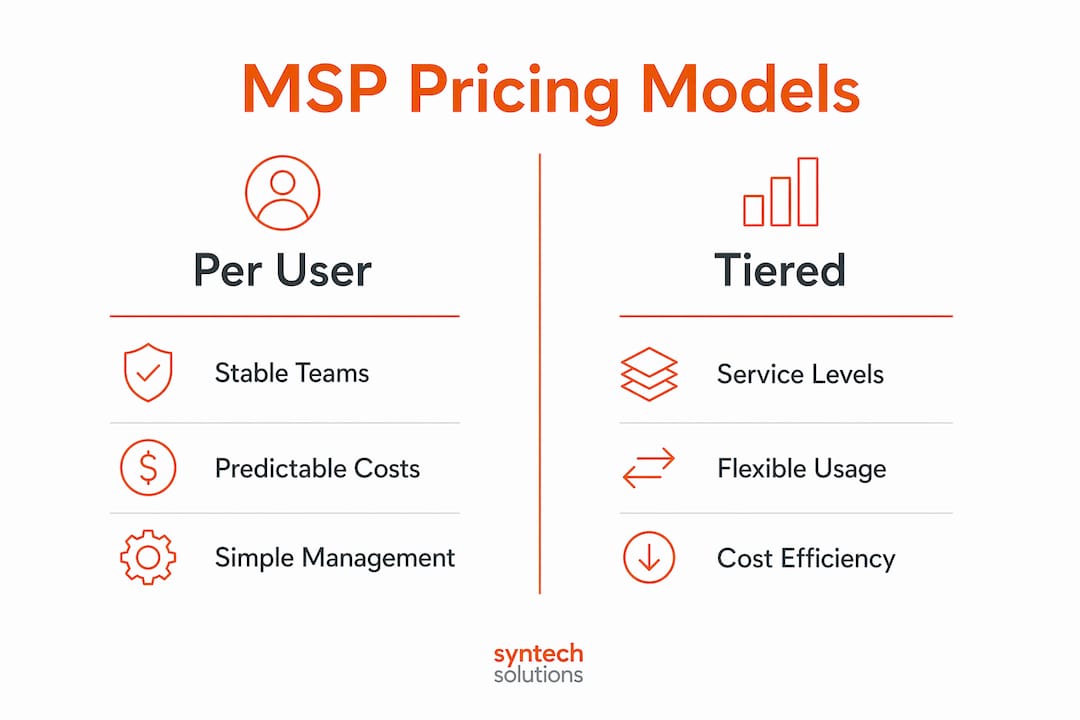
| Pricing model | Best for | Pros | Cons |
|---|---|---|---|
| Per user / per device | Companies with stable headcounts | Predictable monthly costs | Can scale expensively with growth |
| Tiered (basic to premium) | Businesses wanting flexible coverage | Easy to upgrade as needs grow | Lower tiers may exclude critical services |
| Flat-rate all-inclusive | Companies wanting full coverage | No surprise invoices | Higher base cost regardless of usage |
Monthly fees scale with infrastructure complexity, the number of users, and the services included. A 50-person engineering firm with cloud infrastructure and compliance requirements will pay more than a 20-person office with basic networking needs.
Pro Tip: Evaluate total cost of ownership, not the monthly invoice. Factor in the cost of a security breach, unplanned downtime, and the salary of a full-time IT manager when comparing MSP pricing to in-house alternatives.
How does IT service management (ITSM) make MSPs more effective?
IT service management (ITSM) is the framework that governs how IT services are planned, delivered, and improved. Mid-sized firms reach a maturity threshold where informal IT firefighting becomes unsustainable, and structured ITSM frameworks replace it with repeatable, measurable processes. MSPs that operate within an ITSM framework deliver more consistent outcomes than those that manage IT on an ad hoc basis.
The most widely used ITSM tools in MSP environments are ServiceNow and Jira Service Management. Both platforms provide ticketing, change management, and reporting dashboards that give clients visibility into what is happening with their IT environment. ITSM as a philosophy aligns IT delivery with business goals, not just technical tasks.
The practical benefits of ITSM integration for mid-sized businesses include:
- Standardised processes: Every request, change, and incident follows a defined workflow, reducing errors and improving resolution times.
- Business alignment: IT priorities are mapped to business objectives, so the MSP focuses on what actually matters to your operations.
- Measurable outcomes: SLA reports, uptime statistics, and incident logs give executives clear evidence of performance.
- Continuous improvement: ITSM frameworks include regular reviews that identify recurring problems and address root causes.
An MSP that uses ITSM principles functions as a strategic IT advisor, not just a helpdesk. That distinction matters when your business is growing and IT decisions have direct revenue implications.
What criteria should you use to select a managed service provider?
Selecting an MSP is a long-term commitment, and the evaluation process determines whether the partnership delivers value or creates new problems. Transparent reporting on security posture and response metrics is a stronger success indicator than price or marketing promises. Ask every candidate provider to show you sample reports before you sign anything.
Use this evaluation framework:
- Industry-specific expertise: An MSP serving engineering and financial firms understands compliance requirements, data sensitivity, and the operational rhythms of those industries. Generic IT support does not.
- Scalability: The provider must support your business at 50 staff and at 200. Confirm their capacity and pricing structure for growth scenarios.
- Onboarding transparency: The first 30–90 days of an MSP engagement are intensive. Credential collection, asset documentation, and licence alignment require internal resource allocation. A good MSP sets clear expectations upfront.
- Strategic advisory capacity: The best providers conduct detailed audits and align IT with business goals from day one, not just take over existing tasks.
- Cybersecurity contract clarity: Confirm exactly which security responsibilities the MSP owns and which remain with your team. Ambiguity here creates risk during audits and incidents.
Avoid any provider that positions itself primarily as a break-fix vendor. That model is incompatible with the proactive, strategic IT management that mid-sized businesses need.
Key takeaways
A managed service provider delivers the most value when treated as a long-term strategic IT partner, not a reactive support vendor.
| Point | Details |
|---|---|
| Proactive model beats break-fix | MSPs with SLAs and 24/7 monitoring reduce downtime and prevent incidents before they escalate. |
| Pricing requires full cost analysis | Evaluate total cost of ownership, including breach risk and downtime, not just the monthly fee. |
| ITSM integration drives outcomes | MSPs using ServiceNow or Jira Service Management deliver measurable, business-aligned IT results. |
| Onboarding takes 30–90 days | Allocate internal resources for the transition period to avoid delays and gaps in coverage. |
| Shared cybersecurity responsibility | Define roles clearly in contracts so accountability for human risks like phishing is never ambiguous. |
What I have learned from watching MSP partnerships succeed and fail
The businesses that get the most from their MSP relationships share one trait: they treat the provider as an extension of their leadership team, not a supplier to manage at arm’s length. The ones that struggle almost always made the same mistake. They signed a contract expecting the MSP to fix everything without any internal engagement, then blamed the provider when outcomes fell short.
The onboarding phase is where most partnerships are won or lost. I have seen companies underestimate the internal effort required in those first 90 days and then lose confidence in the MSP when timelines slip. The friction is normal. It is the cost of building a properly documented, secure IT environment for the first time.
The other pattern worth noting is the tendency to evaluate MSPs on price alone. A provider charging less per month but offering no strategic advisory, no ITSM framework, and no compliance expertise will cost far more over three years than a slightly more expensive partner who prevents one serious breach. South African businesses in regulated industries cannot afford that trade-off.
— Steven
How Techtron supports mid-sized South African businesses with managed IT
Techtron provides fully managed and co-managed IT services designed for South African professional service firms with 20 to 300 staff. Services include proactive monitoring, cybersecurity, Microsoft 365 and Azure cloud management, and backup and disaster recovery. Techtron understands the local regulatory environment, including POPIA compliance requirements, and structures service tiers to match both your current needs and your growth plans. If you are evaluating whether a co-managed IT approach fits your existing internal team, Techtron offers consultations to map the right model for your business.
FAQ
What does a managed service provider do?
A managed service provider remotely manages a company’s IT infrastructure under a service agreement, covering monitoring, cybersecurity, cloud services, and helpdesk support. The goal is proactive management that prevents problems rather than reacting to them after they occur.
What is the difference between an MSP and a break-fix IT provider?
A break-fix provider charges per incident and only engages when something fails. An MSP charges a recurring fee and actively monitors and maintains systems to prevent failures before they affect the business.
How long does MSP onboarding take?
The initial onboarding phase typically takes 30–90 days. This period covers credential collection, asset documentation, and licence alignment, and requires active participation from the client’s internal team.
What is ITSM and why does it matter for MSP selection?
IT service management (ITSM) is a framework that structures how IT services are delivered and improved. MSPs that operate within ITSM frameworks, using tools like ServiceNow or Jira Service Management, deliver more consistent and measurable outcomes than those without structured processes.
Who is responsible for cybersecurity when using an MSP?
Cybersecurity responsibility is shared. The MSP manages technical controls, monitoring, and incident response, but the client retains accountability for human risks such as phishing. Contract terms should define these boundaries clearly before the engagement begins.