

Complete Guide to Backup vs Archiving in IT
Most business leaders are surprised to learn that over 40 percent of companies still confuse backups with archival storage, risking costly mistakes in their IT strategies. In a data-driven world where compliance demands and cyber threats continue to grow, understanding these two approaches is key to protecting your organization’s future. This guide unpacks the critical distinctions and practical value of backup versus archiving so you can make smart, informed decisions for lasting data security.
Key Takeaways
| Point | Details |
|---|---|
| Backup vs. Archiving | Backups are for operational recovery, while archiving focuses on long-term data preservation and compliance needs. |
| Retention and Access | Backup data is temporarily stored for quick recovery; archives maintain data for years with controlled access for regulatory purposes. |
| Business Continuity | Effective backup systems are essential for minimizing downtime in various sectors, while archives support legal compliance and historical reference. |
| Risk Management | Organizations must proactively address risks associated with inadequate backups and archiving to avoid costly data loss and compliance violations. |
Defining Backup and Archiving Solutions
In the complex world of information technology, backup and archiving are often confused but represent fundamentally different data management strategies. According to the National Archives and Records Service, these are distinct processes with unique purposes in organizational data protection.
A backup is essentially a safety net for operational data recovery. It creates duplicate copies of active files and systems that can be quickly restored in case of accidental deletion, hardware failure, or system crash. Think of backups like a spare tire in your car – they’re immediate, short-term solutions designed to get you back on track quickly. These copies are typically maintained for relatively short periods and are constantly refreshed to reflect the most current operational state of your digital environment.
Archiving, by contrast, serves a different strategic purpose. As outlined by National Archives, archives are long-term repositories of historical records preserved for reference, compliance, and potential future analysis. Unlike backups, archives are not about immediate recovery but about maintaining a permanent, organized record of an organization’s digital history. Key characteristics of archiving include:
- Permanent storage of historical data
- Compliance with legal and regulatory requirements
- Structured, searchable preservation of important documents
- Reduced storage costs by moving infrequently accessed data to more economical platforms
While backups focus on operational continuity, archives focus on long-term information management and organizational memory. Understanding this distinction is crucial for developing a comprehensive data protection strategy that addresses both immediate recovery needs and long-term information preservation.

For a deeper understanding of how these strategies differ, check out our guide on backup and disaster recovery.
Key Differences: Purpose, Methods, and Access
Backup and archiving solutions differ dramatically in their fundamental approach to data management. National Archives clearly distinguishes these strategies by highlighting their unique purposes, methodologies, and access protocols.
The primary purpose divergence is stark. Backups are designed for operational recovery – creating rapid, temporary copies of active data that can be swiftly restored during system failures or accidental deletions. They’re dynamic, short-term solutions constantly refreshed to mirror the current operational state. In contrast, archives serve a strategic, long-term preservation function, maintaining historical records for compliance, research, and organizational memory.
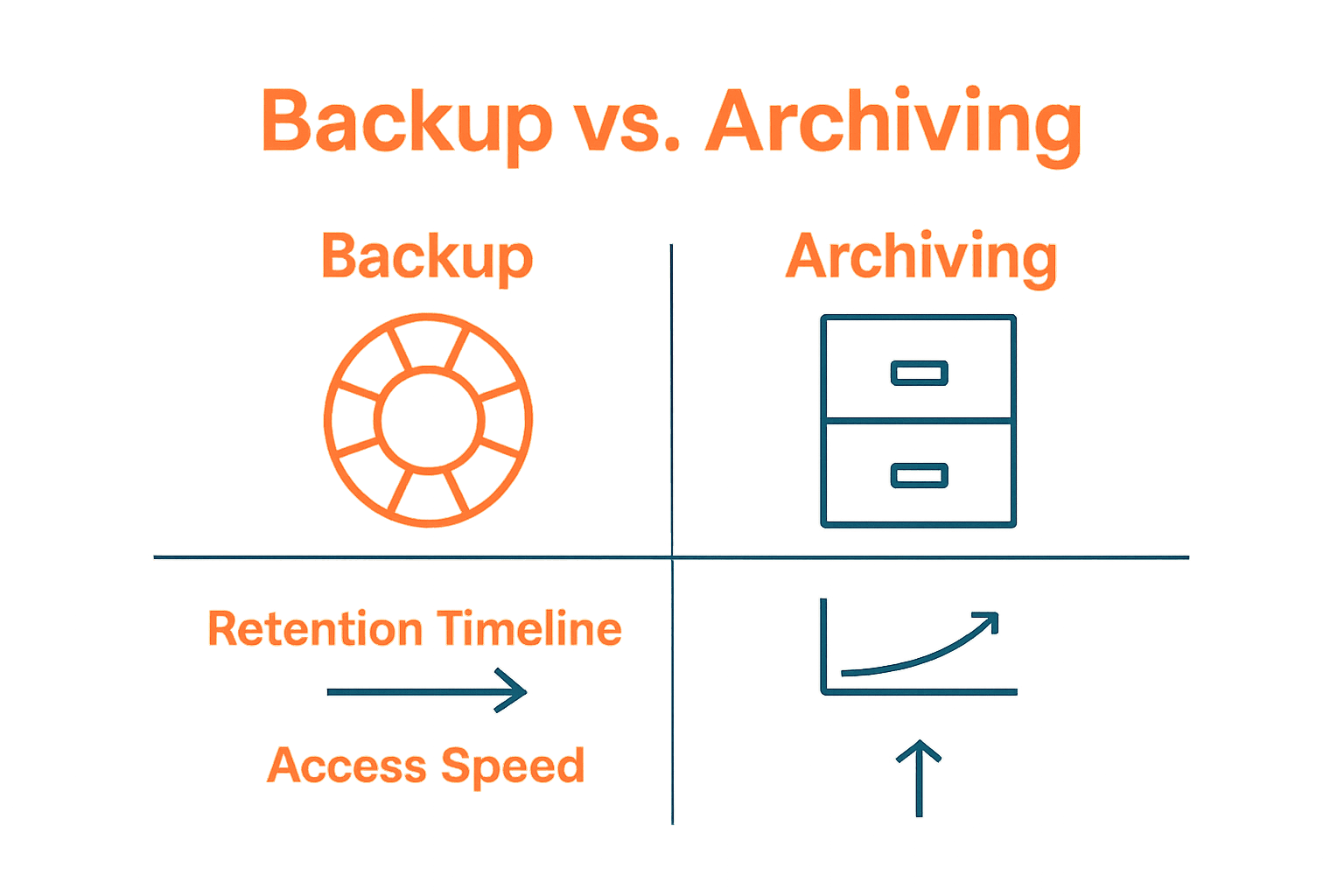
Methodologically, these solutions employ distinct storage and management techniques. Backup systems typically use incremental or full backup strategies that overwrite previous versions, ensuring the most recent operational snapshot is always available. Archives, however, preserve data in a fixed, unaltered state. Key methodological differences include:
-
Backup frequency: Frequent (daily/hourly)
-
Storage approach: Overwritable and dynamic
-
Retention period: Short-term (days to months)
-
Access speed: Immediate recovery
-
Archive frequency: Infrequent, structured
-
Storage approach: Permanent and immutable
-
Retention period: Long-term (years to decades)
-
Access speed: Structured, controlled retrieval
Access protocols further distinguish these solutions.
VIDEO:video_content] As outlined by the [National Archives, backups are designed for widespread, quick organizational access during emergencies. Archives, conversely, feature restricted, carefully managed access to maintain the integrity of historical records. This controlled access ensures that critical historical information remains pristine and protected from unintended modifications.
For professionals seeking deeper insights into data management strategies, our guide on backup and disaster recovery offers comprehensive exploration of these critical technological approaches.
Typical Use Cases in Business IT
In the dynamic world of business technology, backup and archiving solutions play critical roles across various industry sectors. National Archives highlights that these strategies are not just technical necessities, but fundamental components of organizational data management and risk mitigation.
Backups are the frontline defense for operational continuity. Financial services, engineering firms, and professional service companies rely on robust backup systems to protect against potential data catastrophes. When a critical system fails, gets infected by malware, or experiences hardware breakdown, backups enable rapid recovery. A marketing agency might lose weeks of client campaign designs, or an engineering firm could risk millions in project documentation without effective backup strategies.
Archiving serves a different but equally crucial purpose. As outlined by the National Archives, these solutions support organizational accountability, legal compliance, and historical record-keeping. Different industries leverage archives uniquely:
- Financial Services: Maintain transaction records for regulatory compliance
- Healthcare: Preserve patient records for long-term medical history
- Legal Firms: Store case documents and client communications
- Research Institutions: Archive scientific data and experimental records
- Government Agencies: Maintain official documents for transparency
The strategic implementation of backup and archiving goes beyond simple data preservation. These systems protect intellectual property, ensure business continuity, and provide a structured approach to managing an organization’s digital assets. Compliance requirements often mandate specific retention periods and access controls, making these solutions not just technical tools, but critical business infrastructure.
Here’s a comparison of backup and archiving solutions in business IT environments:
| Aspect | Backup | Archiving |
|---|---|---|
| Primary Purpose | Operational recovery | Long-term preservation |
| Data Retention | Short-term Days to months |
Long-term Years to decades |
| Access Speed | Immediate, fast restoration | Structured, controlled retrieval |
| Storage Approach | Overwritable Dynamic snapshots |
Permanent Immutable records |
| Typical Use Cases | System failure recovery Malware incidents Accidental deletion |
Compliance Historical analysis Regulatory audits |
| Compliance Role | Business continuity | Legal/regulatory requirements |
| Common Industries | Financial services Engineering Marketing |
Healthcare Legal firms Government |
Professional IT leaders understand that choosing the right data management strategy requires careful consideration of business automation trends and technological capabilities.
Compliance, Legal, and Retention Requirements
Legal compliance and data retention represent critical challenges for modern organizations navigating complex regulatory landscapes. South African Revenue Service emphasizes that businesses must maintain systematic record-keeping strategies that satisfy multiple legal requirements across different sectors.
For financial and professional service organizations, retention requirements extend far beyond simple data storage. Businesses must implement sophisticated backup and archiving solutions that can demonstrate precise, auditable data management. Different industries face unique compliance challenges – financial firms might need to retain transaction records for seven years, while healthcare organizations must preserve patient records for decades, each with specific access and protection protocols.
Retention requirements typically involve multiple critical dimensions:
- Mandatory Retention Periods
- Legal accessibility of records
- Data integrity and authenticity
- Secure storage mechanisms
- Controlled access protocols
- Verifiable documentation trails
As outlined by the National Archives, governmental and private sector organizations must develop comprehensive record management strategies that go beyond basic storage. These strategies must ensure:
- Systematic documentation management
- Compliance with specific industry regulations
- Protection of sensitive information
- Efficient retrieval capabilities
- Audit trail maintenance
Navigating these complex requirements demands more than technical solutions – it requires a strategic approach to information governance. Organizations must balance operational needs with legal mandates, implementing flexible yet robust data management systems that can adapt to evolving regulatory landscapes.
For professionals seeking deeper insights into managing these intricate compliance challenges, our guide on IT compliance requirements offers comprehensive strategies for effective organizational data management.
Risks, Costs, and Common Pitfalls
Navigating the complex landscape of backup and archiving requires understanding the potential risks and hidden costs that can cripple unprepared organizations. National Archives warns that improper data management can lead to catastrophic consequences beyond simple data loss.
The financial implications of inadequate backup strategies can be devastating. A single system failure or data breach could result in productivity losses, legal penalties, and irreparable reputational damage. Small to mid-sized businesses are particularly vulnerable, with potential recovery costs ranging from tens of thousands to millions of rands. Critical risks include permanent data destruction, extended operational downtime, and compliance violations that can trigger severe regulatory penalties.
Common pitfalls in backup and archiving strategies include:
- Insufficient Backup Frequency: Infrequent backups leave massive data gaps
- Neglecting Disaster Recovery Testing
- Inadequate Storage Redundancy
- Poor Encryption Practices
- Ignoring Scalability Requirements
- Failing to Implement Comprehensive Monitoring
As outlined by the National Archives, organizations must proactively address potential risks through comprehensive records management. This involves not just implementing backup systems, but developing robust strategies that anticipate potential failure points, ensure data integrity, and maintain strict compliance standards.
Professional IT leaders recognize that mitigating these risks requires more than technical solutions – it demands a strategic approach to understanding IT risk assessment processes, creating multi-layered protection strategies that safeguard an organization’s most critical asset: its data.
Secure Your Business Data with Expert Backup and Archiving Solutions
Managing data with proper backup and archiving is no easy task. The risk of data loss, compliance breaches and operational downtime can feel overwhelming. This article highlights the vital difference between backup as an immediate safety net and archiving as long-term preservation. Understanding these concepts is the first step toward protecting your business from costly disruptions and regulatory penalties.
At Techtron, we specialise in tailored IT services that address these exact challenges. Whether you need robust backup and disaster recovery solutions to quickly restore critical systems or structured archiving to meet compliance demands, our managed IT offerings provide peace of mind and operational continuity. Don’t wait till an incident threatens your data integrity. Act now to safeguard your digital assets, maintain compliance and reduce your technical risks with expert support.
Explore how our comprehensive services can transform your data management strategy today at Techtron and take control of your business IT future.
Frequently Asked Questions
What is the main difference between backup and archiving?
Backups are designed for operational recovery, creating temporary copies of active data for quick restoration after data loss events, while archiving serves to maintain long-term, immutable records for compliance and historical reference.
How often should backups be performed compared to archiving?
Backups are usually performed frequently, such as daily or hourly, to ensure the most current data is available for recovery. In contrast, archiving is done infrequently, capturing data that is no longer actively used but still needs to be preserved.
What are the typical use cases for backups in a business environment?
Backups are commonly used for recovering from system failures, malware attacks, and accidental deletions. They serve as a critical line of defense to maintain business continuity and protect operational data.
Why is compliance important in archiving strategies?
Compliance is crucial in archiving because organizations must adhere to legal and regulatory requirements for data retention. Properly implemented archiving solutions ensure that important documents are preserved, accessible, and maintain their integrity over time.