

Business benefits of remote monitoring in 2026
Remote monitoring is often misunderstood as simple system oversight, yet it delivers transformative business value for mid-sized professional service firms. Beyond basic alerts, remote monitoring provides continuous oversight of IT systems from any location, enabling proactive management of infrastructure, enhanced security postures, and operational efficiency gains. For IT managers and decision-makers at firms with 20 to 300 staff, understanding these multifaceted benefits is crucial for strategic planning in 2026. This article clarifies how remote monitoring optimizes operations, strengthens security, and aligns IT strategy with business goals.
Key takeaways
| Point | Details |
|---|---|
| Operational efficiency | Remote monitoring delivers real-time insights that reduce downtime and accelerate issue resolution. |
| Security enhancement | Continuous oversight detects threats early, minimizing exposure to cyber risks and data breaches. |
| Proactive compliance | Automated monitoring simplifies audit trails and regulatory reporting for professional service firms. |
| Strategic alignment | Choosing the right solutions ensures IT infrastructure supports business objectives and scalability. |
What is remote monitoring and why it matters for your business
Remote monitoring uses specialized tools and services to observe IT systems, networks, and applications from centralized or distributed locations without physical presence. For mid-sized professional service firms operating hybrid teams or multiple offices, this capability transforms how IT infrastructure is managed. Traditional reactive approaches wait for users to report problems, creating costly downtime and frustrated staff. Remote monitoring flips this model by detecting issues before they impact operations.
Core functions include continuous system health checks, automated alerting when thresholds are breached, performance tracking across endpoints and networks, and security event detection. These capabilities work together to support uninterrupted business operations. When a server begins showing memory degradation at 2 AM, remote monitoring alerts your IT team immediately rather than waiting for morning complaints about sluggish applications. This proactive stance minimizes disruption and maintains productivity.
The remote monitoring guide for South African businesses 2025 emphasizes that continuous oversight enables faster response times and better resource allocation. For professional service firms where billable hours and client deliverables depend on reliable technology, even brief outages translate directly to revenue loss. Remote monitoring acts as an early warning system, catching problems in their infancy.
Consider the typical challenges facing engineering or financial firms with distributed teams:
- Employees working remotely need consistent access to cloud applications and data
- Client confidentiality requires robust security monitoring across all endpoints
- Regulatory compliance demands documented oversight and rapid incident response
- Limited IT staff must manage growing infrastructure complexity efficiently
Remote monitoring addresses each challenge by providing visibility into systems regardless of physical location. Your IT team gains a unified view of network performance, application health, security events, and user activity. This comprehensive perspective enables informed decisions about infrastructure investments, security priorities, and operational improvements. The ability to enhance cybersecurity in SaaS platforms becomes significantly easier when monitoring tools provide real-time threat intelligence.
Pro Tip: Start by identifying your three most critical business systems and implement monitoring there first. This focused approach delivers quick wins while building team confidence in the technology.
Key business benefits of remote monitoring
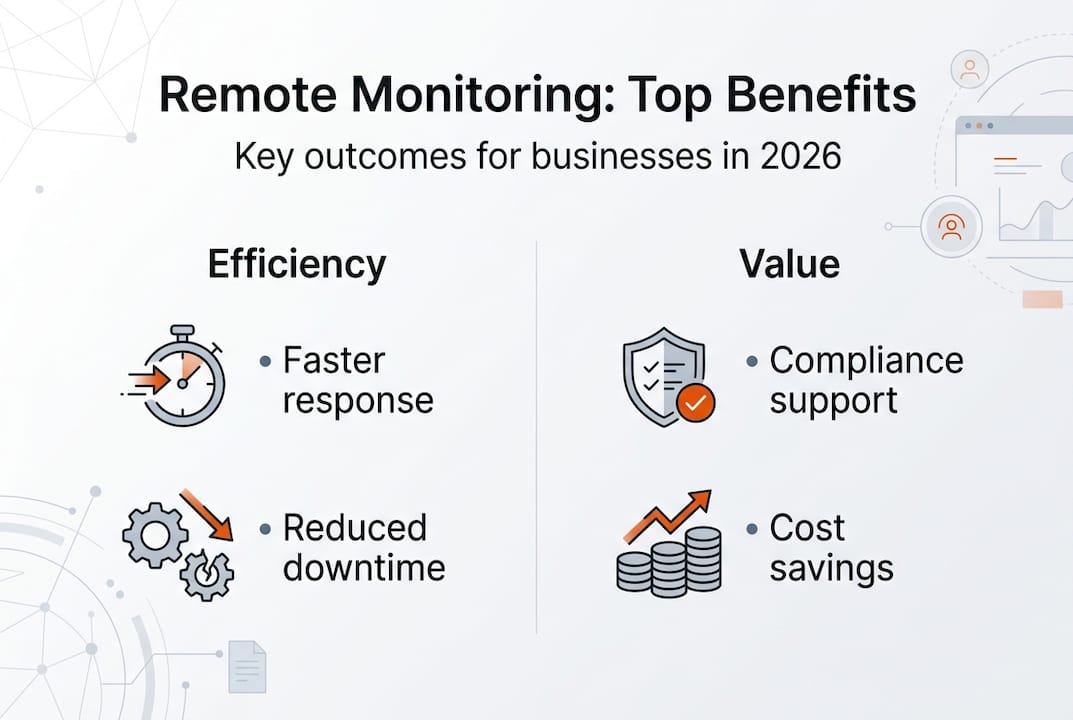
The tangible advantages of remote monitoring extend far beyond simple system uptime, touching every aspect of IT operations and business continuity. Remote monitoring leads to faster issue resolution by detecting anomalies before they cascade into major failures. When your monitoring system alerts that a backup job failed overnight, IT can investigate and resolve the issue before the next backup window, ensuring data protection remains intact.

Enhanced uptime directly impacts revenue and reputation. Professional service firms bill for expertise and deliverables, both of which require functioning technology. Every hour of system unavailability represents lost productivity, missed deadlines, and potentially damaged client relationships. Remote monitoring reduces unplanned downtime by catching hardware failures, software conflicts, and performance degradation early. The cost savings from avoiding even one major outage often justifies the entire monitoring investment.
Operational efficiency improves through better resource allocation and informed capacity planning. Monitoring data reveals usage patterns, bottlenecks, and underutilized resources. You might discover that certain applications consume excessive bandwidth during peak hours, enabling targeted optimization. Or identify servers running at 20% capacity that could be consolidated, reducing infrastructure costs. These insights transform IT from a cost center into a strategic asset.
Security benefits represent perhaps the most critical advantage in 2026. Improved security posture is a common advantage cited by IT managers using remote monitoring. Continuous surveillance detects unauthorized access attempts, unusual data transfers, malware signatures, and policy violations in real time. When an employee’s laptop begins communicating with a known command and control server, immediate alerts enable rapid containment before data exfiltration occurs.
Key security benefits include:
- Early detection of ransomware encryption activity through file system monitoring
- Identification of compromised credentials via unusual login patterns and locations
- Real-time blocking of malicious network traffic based on threat intelligence feeds
- Automated compliance checks ensuring security policies remain enforced across all endpoints
Regulatory compliance becomes manageable rather than overwhelming. Professional service firms face increasing scrutiny around data protection, client confidentiality, and operational controls. Remote monitoring provides the audit trails, automated reporting, and documented oversight that regulators expect. When auditors request evidence of security controls, your monitoring system delivers comprehensive logs showing exactly how systems are protected and incidents are handled.
The top 5 benefits of remote network monitoring include reduced mean time to resolution, which directly correlates with business continuity. Faster problem identification and resolution mean less disruption to billable work and client service. The cumulative effect of these benefits transforms IT operations from reactive firefighting to proactive management.
Pro Tip: Establish baseline performance metrics before implementing monitoring, then track improvements quarterly. Demonstrating measurable gains in uptime, response times, and security incidents builds executive support for ongoing investment.
Comparing remote monitoring solutions: features and business impact
Selecting the right remote monitoring solution requires understanding how different types align with specific business needs. Different remote monitoring solutions offer varying features tailored to diverse requirements. The four primary categories are endpoint monitoring, network monitoring, SaaS application monitoring, and cloud infrastructure monitoring. Each serves distinct purposes while often overlapping in enterprise environments.
Endpoint monitoring tracks individual devices like laptops, desktops, and mobile devices. This proves essential for firms with remote workers, ensuring security policies are enforced and performance remains consistent regardless of location. Network monitoring focuses on routers, switches, firewalls, and overall traffic patterns, identifying bottlenecks and security threats at the infrastructure level. SaaS monitoring observes cloud applications like Microsoft 365, tracking availability, performance, and user experience. Cloud infrastructure monitoring manages virtual machines, storage, and services in platforms like Azure.
| Solution Type | Key Features | Primary Business Impact |
|---|---|---|
| Endpoint Monitoring | Device health, security compliance, software inventory, remote troubleshooting | Protects distributed workforce, ensures policy enforcement, reduces support costs |
| Network Monitoring | Traffic analysis, bandwidth usage, device status, security event correlation | Optimizes performance, detects intrusions, supports capacity planning |
| SaaS Monitoring | Application availability, user experience metrics, integration health, usage analytics | Ensures productivity tools remain accessible, identifies adoption issues |
| Cloud Infrastructure | Resource utilization, cost tracking, scaling alerts, backup verification | Controls cloud spending, maintains availability, supports disaster recovery |
When evaluating solutions, prioritize features that address your specific pain points. Alerting mechanisms should be customizable to avoid notification fatigue while ensuring critical issues receive immediate attention. Look for solutions offering multiple alert channels like email, SMS, and integration with collaboration platforms. Reporting capabilities must provide both technical detail for IT staff and executive summaries for leadership.
Scalability matters significantly for growing firms. A solution perfect for 50 employees may struggle at 200. Evaluate whether the platform can add monitored devices, users, and data sources without performance degradation or cost explosions. Integration support determines how well monitoring fits into existing workflows. Can it feed data into your ticketing system? Does it connect with security information and event management tools? Seamless integration reduces manual work and improves response times.
Consider these selection criteria:
- Does the solution monitor all critical systems in your environment?
- Can alerts be customized by severity, system type, and business impact?
- Does reporting support both operational and compliance requirements?
- Will the platform scale as your firm grows without requiring replacement?
- How easily does it integrate with existing IT management tools?
The reasons to use remote monitoring extend beyond technology to business outcomes. A well-chosen solution aligns monitoring capabilities with strategic goals like improving client service, reducing operational costs, and maintaining competitive advantage through reliable technology.
Pro Tip: Request trial periods from multiple vendors and test them against real scenarios from your environment. Nothing reveals fit better than monitoring your actual systems under typical conditions.
Implementing remote monitoring effectively in your firm
Successful implementation requires methodical planning and stakeholder engagement from the outset. Successful remote monitoring implementation requires clear strategy, staff buy-in, and continuous optimization. Rushing deployment without proper preparation leads to alert fatigue, poor adoption, and wasted investment. Follow this structured approach for optimal results:
-
Assess current state and requirements by documenting all systems requiring monitoring, identifying critical business processes dependent on technology, and defining success metrics like uptime targets and response time goals.
-
Select appropriate solutions based on your assessment, prioritizing platforms that address the highest-risk areas first while ensuring compatibility with existing infrastructure and future growth plans.
-
Plan phased deployment starting with critical systems to demonstrate value quickly, then expanding to additional infrastructure as team expertise grows and processes mature.
-
Train staff thoroughly on both technical operation and business context, ensuring everyone understands why monitoring matters and how their role contributes to success.
-
Establish response procedures defining who receives alerts for different scenarios, what actions are required at each severity level, and how incidents are documented and reviewed.
-
Monitor and optimize continuously by reviewing alert accuracy, adjusting thresholds to reduce false positives, and incorporating lessons learned from incidents into improved monitoring rules.
Common implementation challenges include alert fatigue from poorly tuned thresholds generating excessive notifications. Combat this by starting with conservative settings that only flag genuine issues, then refining based on actual experience. Integration complexity can overwhelm teams unfamiliar with APIs and data flows. Address this through vendor support, professional services, or partnering with experienced managed service providers.
Data overload represents another frequent obstacle. Monitoring generates vast amounts of information, but not all of it requires immediate attention. Implement filtering and prioritization so critical alerts stand out while routine data feeds into trend analysis and capacity planning. The remote team management solutions discussion highlights how proper tooling supports distributed teams.
Measure success through concrete KPIs rather than subjective impressions. Track metrics like:
- Mean time to detect issues, comparing before and after monitoring implementation
- Mean time to resolve incidents, demonstrating faster response enabled by early detection
- System uptime percentage, showing reliability improvements
- Security incidents detected and prevented, quantifying risk reduction
- Cost per incident, revealing efficiency gains from proactive management
Involve business stakeholders early to align monitoring goals with organizational objectives. IT managers sometimes focus purely on technical metrics while executives care about business impact. Translate monitoring capabilities into language leadership understands like reduced client complaints, improved billable utilization, and lower insurance premiums from better security postures.
Pro Tip: Create a monthly monitoring scorecard showing key metrics, notable incidents prevented, and optimization actions taken. This keeps leadership informed while demonstrating ongoing value from the monitoring investment.
How Techtron supports your remote monitoring journey
Navigating the complexities of remote monitoring implementation becomes significantly easier with experienced guidance. Techtron specializes in helping mid-sized professional service firms optimize their IT infrastructure through tailored monitoring solutions and proactive management. Our approach begins with comprehensive assessment of your current environment, identifying gaps and opportunities that align monitoring capabilities with business priorities.
We provide expertise in IT infrastructure management strategies South Africa specifically designed for firms requiring robust oversight without excessive complexity. Our services include configuring monitoring platforms to your unique requirements, establishing alert thresholds that balance responsiveness with manageability, and training your team on effective use of monitoring data for decision-making.
The foundation of effective monitoring starts with knowing exactly what you have. Our IT asset management guide businesses 2025 helps firms establish comprehensive inventories that inform monitoring strategies. Proper documentation, covered in our IT documentation best practices, ensures monitoring configurations remain current as your environment evolves. This integrated approach transforms monitoring from isolated tooling into strategic infrastructure management supporting your business objectives throughout 2026 and beyond.
Frequently asked questions
What are the key challenges of remote monitoring and how to address them?
Alert fatigue tops the list, occurring when poorly configured systems generate excessive notifications that teams begin ignoring. Address this by carefully tuning thresholds based on actual baseline performance and implementing escalation policies that route different severity levels appropriately. Data privacy concerns arise when monitoring captures sensitive information, requiring clear policies on what gets logged, who can access it, and how long it’s retained. Technology integration challenges emerge when monitoring tools don’t communicate effectively with existing systems, solvable through API-based platforms and professional implementation support. Starting small with critical systems and expanding gradually helps teams build expertise while avoiding overwhelming complexity.
How does remote monitoring support regulatory compliance?
Monitoring provides automated audit trails documenting system access, configuration changes, and security events that regulators require. Real-time alerts for compliance breaches like unauthorized access attempts or policy violations enable immediate response, demonstrating due diligence. Reporting capabilities simplify generating evidence for audits, with comprehensive logs showing exactly how systems are protected and incidents are handled. For professional service firms subject to data protection regulations, monitoring proves security controls are actively enforced rather than merely documented. This proactive approach significantly reduces compliance risk while streamlining audit preparation.
Can remote monitoring reduce operational costs?
Absolutely, through multiple mechanisms that compound over time. Faster problem resolution reduces downtime costs, particularly valuable for professional service firms where every hour of system unavailability represents lost billable work. Optimized resource allocation prevents over-provisioning while ensuring adequate capacity, controlling infrastructure spending. Preventing major outages through early detection avoids expensive emergency responses and potential data recovery costs. Improved efficiency allows existing IT staff to manage larger environments without proportional headcount increases. Many firms find monitoring investments pay for themselves within months through avoided incidents and operational improvements.
What should firms look for when choosing a remote monitoring solution?
Prioritize scalability to ensure the platform grows with your business without requiring replacement or major reconfiguration. Integration capabilities determine how well monitoring fits into existing workflows and tools, reducing manual work. Alert customization allows tuning notifications to your specific environment and team structure, preventing fatigue while ensuring critical issues receive attention. Vendor support quality matters significantly during implementation and ongoing operation, so evaluate responsiveness and expertise. Most importantly, align features with specific business goals rather than selecting based on feature count alone. The right solution addresses your unique challenges while supporting strategic objectives like improved security, compliance, or operational efficiency.