

Business Intelligence Explained: Data-Driven Decision Power
Over 70 percent of businesses believe data-driven decisions are key to staying competitive in today’s market. With so much information pouring in from every direction, companies need smart ways to turn raw data into real value. Business intelligence provides the structure and tools needed to uncover hidden patterns, spot new trends, and help organizations move confidently from guesswork to insight.
Key Takeaways
| Point | Details |
|---|---|
| Business Intelligence (BI) Fundamentals | BI converts raw data into strategic insights, aiding organizations in performance improvement and informed decision-making. |
| Key BI Stages | The BI process includes data acquisition, cleaning, manipulation, analytics, and visualization to derive actionable insights. |
| Types of BI Solutions | BI solutions encompass historical, operational, situational, and self-service categories, each serving different analytical needs. |
| Implementation Challenges | Successful BI implementation requires managing technology compatibility, data quality, staff training, and addressing financial risks. |
Table of Contents
- Defining Business Intelligence And Core Concepts
- Types Of Business Intelligence Solutions
- Key Features And How Bi Works
- Business Intelligence Use Cases For Firms
- Risks, Costs, And Implementation Challenges
Defining Business Intelligence and Core Concepts
Business intelligence transforms raw data into strategic insights that power smart decision-making across modern organisations. According to the University of South Africa library guide, business intelligence encompasses the applications, infrastructure, tools, and best practices that enable organisations to access and analyse critical information for improving performance and making strategic choices.
At its core, business intelligence represents an evidence-based approach to organisational decision-making. Research from the University of Pretoria highlights that this approach involves several key stages:
- Data Acquisition: Collecting relevant information from multiple sources
- Data Cleaning: Ensuring data accuracy and removing inconsistencies
- Data Manipulation: Preparing datasets for meaningful analysis
- Analytics: Applying sophisticated techniques to extract actionable insights
- Visualization: Presenting complex information through intuitive graphics and reports
The ultimate goal of business intelligence goes beyond mere data collection. As described by academic research, BI aims to transform complex information into clear, actionable strategies that enable businesses to:
- Make faster, more informed decisions
- Identify emerging market trends
- Understand competitive landscapes
- Optimize operational efficiency
- Predict potential business challenges
By integrating advanced technological tools with strategic thinking, business intelligence empowers organisations to turn raw data into their most valuable asset.

Types of Business Intelligence Solutions
Business intelligence solutions have evolved dramatically, offering organisations a range of tools to transform data into strategic insights. According to research from the Regent Business School, South African businesses leverage diverse BI platforms that cater to different analytical needs, including Microsoft Power BI, Tableau, SQL, Excel, SAS, and IBM Cognos Analytics.
Key Categories of Business Intelligence
Here’s a summary of the main types of business intelligence solutions:
| BI Category | Main Focus | Typical Users |
|---|---|---|
| Historical BI | Past performance Reporting |
Analysts, Managers |
| Operational BI | Real-time monitoring KPIs |
Operations teams |
| Situational BI | Ad hoc questions Time-sensitive |
Executives, Teams |
| Self-Service BI | User-driven analysis Reporting |
Non-technical staff |
Research from a comprehensive 2017 survey paper identifies several critical BI solution categories:
- Historical BI: Analysing past performance and trends
- Operational BI: Real-time monitoring of current business processes
- Situational BI: Addressing specific, time-sensitive business questions
- Self-Service BI: Enabling non-technical users to generate reports and conduct analyses
“The right BI solution can turn complex data into clear, actionable strategies.”
These solutions differ primarily in their approach and accessibility.
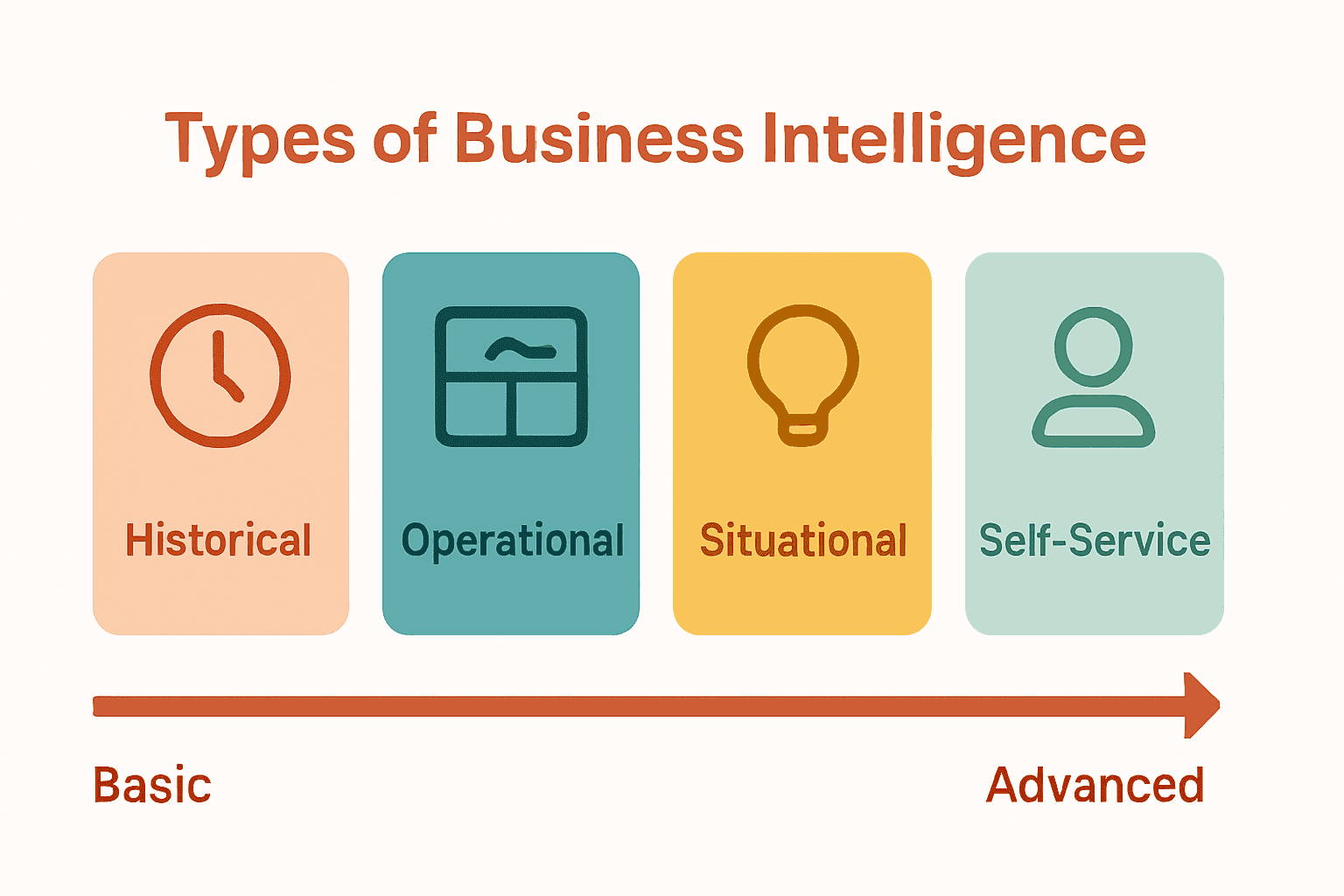 Historical BI helps organisations understand past performance by providing retrospective insights. Operational BI, in contrast, focuses on real-time data streams, allowing businesses to monitor key performance indicators as they happen. Situational BI offers targeted insights for specific challenges, while self-service BI democratizes data analysis by giving non-technical team members powerful analytical tools.
Learn more about AI-powered business intelligence tools that can further enhance your organisation’s data strategy and decision-making capabilities.
Key Features and How BI Works
Business intelligence operates through a sophisticated, multi-stage process that transforms raw data into meaningful strategic insights. According to research from the University of Pretoria’s IRM 801 module, the BI workflow encompasses several critical stages designed to extract maximum value from organisational data.
The BI Data Transformation Process
The core BI workflow involves a systematic approach to data management and analysis:
- Data Acquisition: Collecting information from diverse sources
- Data Cleaning: Removing inconsistencies and ensuring data quality
- Data Manipulation: Structuring and preparing datasets
- Advanced Analytics: Applying complex analytical techniques
- Interpretation: Developing meaningful insights
- Visualization: Creating intuitive graphical representations
Research highlights that modern BI systems go beyond simple reporting. They integrate advanced analytical capabilities that enable organisations to:
- Predict future trends
- Identify potential business opportunities
- Detect operational inefficiencies
- Benchmark performance against industry standards
- Support rapid, data-driven decision-making
“Business intelligence transforms raw information into strategic knowledge.”
The most advanced BI systems even incorporate automated decision-making capabilities, allowing organisations to respond instantly to complex data signals. This means businesses can move from reactive reporting to proactive strategic planning, turning data into a dynamic, actionable asset.
Explore our comprehensive guide to AI-powered business intelligence to understand how cutting-edge technologies are revolutionising data analysis.
Business Intelligence Use Cases for Firms
Business intelligence has become a transformative tool across diverse industries, enabling organisations to make data-driven decisions with unprecedented precision. According to research from the Regent Business School, multiple South African sectors are leveraging BI technologies to gain strategic advantages and operational insights.
Industry-Specific BI Applications
Different industries employ business intelligence in unique and powerful ways:
Retail and Consumer Goods
- Demand Forecasting: Pick n Pay uses BI to analyse consumer purchasing patterns
- Inventory Optimization: Predicting stock requirements and reducing waste
- Customer Behaviour Analysis: Understanding purchasing trends and preferences
Financial Services
- Risk Management: Identifying potential financial vulnerabilities
- Customer Segmentation: Developing targeted marketing strategies
- Fraud Detection: Monitoring transactions for suspicious activities
Healthcare
- Patient Behaviour Tracking: Discovery Health monitors member interactions
- Resource Allocation: Optimising medical resource deployment
- Treatment Outcome Analysis: Improving patient care strategies
“Business intelligence transforms raw data into actionable organisational strategy.”
These use cases demonstrate how BI goes beyond simple reporting. By converting complex data into clear, actionable insights, organisations can make faster, more informed decisions that directly impact their bottom line.
Learn more about integrating AI into business intelligence systems and unlock your organisation’s full analytical potential.
Risks, Costs, and Implementation Challenges
Business intelligence implementations are not without significant complexities and potential pitfalls. A compelling real-world example comes from Reuters reporting on SPAR, a major South African retailer, which experienced substantial operational challenges during a complex SAP IT system rollout, demonstrating the intricate risks associated with advanced technological integrations.
Key Implementation Challenges
Organisations contemplating BI solutions must navigate several critical challenges:
- Technology Compatibility: Ensuring new systems integrate smoothly with existing infrastructure
- Data Quality: Managing and standardising data from multiple sources
- Staff Training: Developing workforce skills to effectively use new analytical tools
- Change Management: Overcoming organisational resistance to new methodologies
Financial and Operational Risks
- High initial investment costs
- Potential operational disruptions during implementation
- Risk of incomplete or ineffective system deployment
- Potential performance degradation
- Cybersecurity vulnerabilities during transition
“Technological transformation requires strategic planning and comprehensive risk management.”
Successful BI implementation demands more than just technological investment. It requires a holistic approach that considers organisational culture, existing technological ecosystems, and long-term strategic objectives. Learn more about mitigating IT implementation risks to ensure a smooth and effective business intelligence strategy.
Unlock Data-Driven Decisions with Seamless IT Support
Are you feeling the strain of turning complex, raw data into clear business strategies, as outlined in our article on business intelligence? If you worry about data quality, technology integration, or overwhelming IT risks, you’re not alone. Many South African professional firms face these hurdles. Business intelligence promises powerful analytics, but success relies on a stable, secure and expertly managed IT environment.
Let Techtron help you take the next step towards smarter, insight-driven decisions. We offer professional IT management and cloud solutions designed to give your teams reliable access to business data, automate security, and ensure operational continuity. Why wait? Discover how enterprise-grade support, proactive security, and seamless infrastructure can amplify your business intelligence investment. Visit Techtron’s home page today and start building a future powered by trusted technology solutions.
Frequently Asked Questions
What is business intelligence?
Business intelligence (BI) refers to the technologies, applications, and practices that transform raw data into strategic insights, enabling organizations to make data-driven decisions for improved performance.
What are the main types of business intelligence solutions?
The main types of BI solutions include Historical BI, which focuses on past performance; Operational BI for real-time monitoring; Situational BI for ad hoc analysis; and Self-Service BI, which empowers non-technical users to generate their own reports.
How does the business intelligence process work?
The BI process involves several stages: Data Acquisition, Data Cleaning, Data Manipulation, Advanced Analytics, Interpretation, and Visualization. This systematic approach helps organizations extract meaningful insights from their data.
What are some common use cases for business intelligence in different industries?
Common use cases for business intelligence include demand forecasting and inventory optimization in retail, risk management and customer segmentation in financial services, and patient behavior tracking and resource allocation in healthcare.