

Master how to assess IT vendors for professional services
Selecting the right IT vendor can make or break your firm’s technology initiatives. Mid-sized professional service firms in South Africa face mounting pressure to choose partners who deliver on promises while staying within budget. Poor vendor choices lead to project delays, cost overruns, and operational disruptions that ripple through your entire organization. This guide equips IT managers with a structured framework to evaluate vendors effectively, ensuring technical alignment, cost efficiency, and long-term strategic fit.
Key Takeaways
| Point | Details |
|---|---|
| Define requirements first | Invest significant time mapping needs across departments to prevent misalignment and improve outcomes. |
| Formal evaluation process | Adopt a structured, formal process to assess vendors against a defined framework to boost project success. |
| Core evaluation criteria | Evaluate vendors on technical capabilities, cost versus value, reputation, service quality, and strategic fit. |
| Weighted scoring matrix | Use a weighted scoring matrix to quantify criteria and maintain objective comparisons across proposals. |
| Stakeholder involvement | Engage finance operations and compliance stakeholders early to capture diverse requirements and buy in. |
Understanding what you need before evaluating vendors
Successful vendor selection begins long before you review proposals. IT managers must invest significant time defining their firm’s exact requirements to avoid misalignment later. Organizations dedicating 30-40% time to requirements see 65% higher vendor satisfaction, proving that preparation directly impacts outcomes.
Start by mapping your current infrastructure, workflows, and pain points. Engineering and finance firms have unique compliance obligations, data security standards, and integration needs that generic solutions cannot address. Document technical specifications like system compatibility, scalability thresholds, and security protocols your vendor must support.
Business requirements matter just as much as technical ones. Identify how the solution should improve productivity, reduce operational costs, or enable new service offerings. Prioritize requirements by impact, separating must-haves from nice-to-haves. This clarity prevents scope creep and keeps vendor discussions focused.
Engage stakeholders across departments early. Your finance team understands budget constraints, while operations staff know daily workflow challenges. Compliance officers highlight regulatory requirements vendors must meet. Collecting these perspectives upfront creates comprehensive requirements that reflect real business needs.
Pro Tip: Create a weighted scoring matrix for requirements before contacting vendors. Assign numerical values to each criterion based on business impact. This objective framework eliminates bias when comparing proposals and keeps evaluation consistent across all vendors.
Thorough preparation also helps you manage IT projects effectively once you select a vendor. Clear requirements become the foundation for contracts, service level agreements, and performance monitoring. They give you leverage when negotiating terms and provide benchmarks for measuring vendor success.
Core criteria to assess IT vendors effectively
Evaluating vendors requires examining multiple dimensions beyond price. Core criteria for assessing IT vendors include technical capabilities, cost vs value, reputation, service/support, and strategic fit. Each criterion reveals different aspects of vendor reliability and long-term viability.
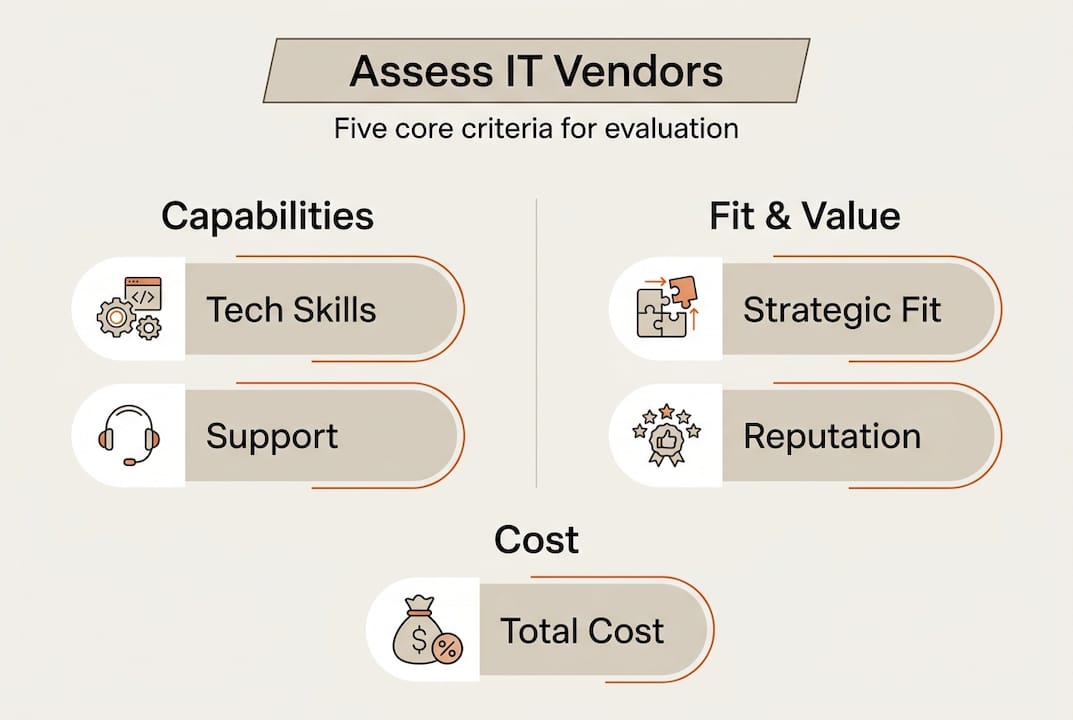
Technical capabilities determine whether the vendor can actually deliver what you need. Assess their technology stack’s compatibility with your existing systems. Can they scale as your firm grows from 50 to 200 staff? Examine their cybersecurity measures, disaster recovery protocols, and data protection standards. Request architecture diagrams and technical documentation to verify claims.

Cost versus value extends beyond sticker price to total cost of ownership. Calculate implementation costs, training expenses, ongoing licensing fees, and maintenance charges. Compare these against expected benefits like productivity gains, risk reduction, and operational savings. Understanding how to reduce IT costs helps you evaluate vendor pricing models critically.
Reputation and references provide social proof of vendor performance. Check independent review sites, industry forums, and peer networks for honest feedback. Request references from clients in similar industries and firm sizes. Ask specific questions about project delivery, problem resolution, and post-implementation support quality.
| Evaluation Criterion | Key Questions | Red Flags |
|---|---|---|
| Technical Fit | Does it integrate with current systems? Can it scale? | Proprietary formats, vendor lock-in |
| Cost Analysis | What is true TCO over 3-5 years? | Hidden fees, unclear pricing |
| Reputation | What do similar firms report? | No verifiable references |
| Service Quality | What are SLA guarantees? Response times? | Vague commitments, no penalties |
| Strategic Alignment | Does their roadmap match our direction? | Declining R&D investment |
Service and support quality determines your experience after purchase. Review service level agreement terms carefully, focusing on response times, availability guarantees, and escalation procedures. Understanding IT service level agreements helps you spot weak commitments. Test their support responsiveness during the evaluation phase by asking technical questions.
Strategic fit ensures long-term partnership viability. Examine the vendor’s technology roadmap and innovation investments. Do they align with your firm’s digital transformation goals? Contrasting viewpoints emphasize strategic and AI fit, with practitioners warning against demos without proof of concepts. Cultural alignment matters too. A vendor who understands professional services workflows will communicate better and anticipate your needs.
Pro Tip: Compare vendors using an IT support services comparison framework. Score each vendor across all five criteria using your weighted matrix. This structured approach reveals which vendor delivers the best overall value, not just the lowest price.
Consider the importance of hard skills assessment when evaluating vendor teams. The technical competence of people delivering your solution directly impacts project success. Request team credentials, certifications, and experience profiles.
Implementing a formal IT vendor evaluation process
Ad hoc vendor selection leads to inconsistent results and missed opportunities. Formal processes yield 40% higher IT project success rates and establish robust IT controls that correlate with better financial management. A structured approach transforms vendor selection from guesswork into strategic decision making.
-
Establish evaluation team and governance. Assemble stakeholders from IT, finance, operations, and compliance. Define roles, decision authority, and evaluation timelines. Create a charter documenting objectives, success criteria, and approval workflows.
-
Document requirements comprehensively. Translate business needs into detailed technical specifications. Include functional requirements, performance benchmarks, security standards, and integration points. Specify compliance obligations and data handling requirements.
-
Develop and issue request for proposals. Create an RFP that clearly communicates requirements, evaluation criteria, and submission guidelines. Include questions that reveal vendor capabilities, pricing models, and implementation approaches. Set realistic deadlines that allow thorough responses.
-
Evaluate proposals systematically. Use your weighted scoring matrix to assess each response objectively. Look beyond marketing language to substance. Verify claims against references and independent research. Shortlist vendors who meet minimum requirements across all criteria.
-
Conduct proof of concept testing. Never rely on demos alone. Require shortlisted vendors to demonstrate their solution with your actual data and workflows. Test integration points, performance under load, and user experience. PoCs reveal gaps that polished demos hide.
-
Negotiate contracts and SLAs. Use evaluation insights to negotiate favorable terms. Push for performance guarantees, flexible scaling options, and exit clauses. Ensure SLAs include measurable commitments with financial penalties for non-compliance.
-
Plan implementation and transition. Work with the selected vendor to create detailed implementation plans. Define milestones, resource commitments, and success metrics. Establish communication protocols and escalation paths.
-
Monitor performance continuously. Vendor evaluation does not end at contract signing. Track performance against SLAs monthly. Conduct quarterly business reviews to address issues and optimize value. This ongoing assessment ensures accountability.
“The difference between successful and failed IT projects often comes down to vendor selection discipline. Firms that treat evaluation as a strategic process rather than a procurement task consistently achieve better outcomes and stronger vendor relationships.”
Comparing outsourced IT vs in-house IT helps contextualize vendor evaluation within broader sourcing strategies. Understanding these trade-offs informs how rigorously you should assess external partners.
Common pitfalls in vendor assessment and how to avoid them
Even experienced IT managers fall into predictable traps during vendor evaluation. Recognizing these pitfalls helps you avoid costly mistakes that undermine project success.
-
Prioritizing price over value. Choosing the cheapest option often leads to higher total costs through poor quality, scope gaps, and change orders. Focus on value delivered relative to investment, not just upfront price.
-
Skipping proof of concept validation. Practitioners warn against relying only on demos without proof of concepts. Demos showcase ideal scenarios with curated data. PoCs reveal how solutions perform with your messy reality.
-
Ignoring cultural and strategic misalignment. Technical fit means nothing if the vendor does not understand your industry, communicate effectively, or share your values. Misaligned partnerships create friction that damages both parties.
-
Underestimating total cost of ownership. Hidden costs emerge after purchase: training, customization, integration, upgrades, and support renewals. Calculate TCO over the solution’s expected lifespan, not just year one.
-
Neglecting stakeholder input. IT managers who evaluate vendors in isolation miss critical requirements and face adoption resistance later. Engage end users, executives, and support staff throughout the process.
-
Rushing decisions under pressure. Tight deadlines tempt shortcuts like skipping reference checks or accepting vague commitments. These shortcuts create risks that far exceed any time saved.
-
Failing to verify vendor financial stability. A vendor’s bankruptcy mid-project leaves you stranded. Review financial statements, funding sources, and market position before committing.
Pro Tip: Create a formal risk assessment for each shortlisted vendor. Identify potential failure modes like technology obsolescence, support quality decline, or acquisition by competitors. Develop mitigation strategies for high-probability risks before signing contracts.
Knowing how to choose the right IT support partner provides additional context for avoiding common vendor selection mistakes specific to managed service providers.
How Techtron can support your IT vendor assessment process
Navigating vendor evaluation requires expertise, time, and objectivity that stretched IT teams struggle to provide. Techtron helps South African professional service firms make confident vendor decisions through structured assessment support and ongoing management.
Our IT documentation best practices service helps you articulate requirements clearly before approaching vendors. We work with your team to map current infrastructure, identify gaps, and document technical specifications that vendors can respond to accurately. This foundation prevents miscommunication and scope disputes.
Techtron’s experience with IT infrastructure management strategies across engineering and finance firms gives us insight into vendor capabilities specific to your industry. We know which vendors deliver on promises and which overpromise. Our vendor assessment consulting includes reference verification, contract review, and PoC facilitation.
We also provide ongoing vendor performance monitoring as part of our managed services. This ensures your selected vendors maintain service quality and meet SLA commitments. When issues arise, we handle escalation and resolution, freeing your team to focus on strategic initiatives.
FAQ
What are the most important criteria when assessing IT vendors?
The five core criteria are technical capabilities, cost versus value, reputation, service and support quality, and strategic alignment. Technical fit ensures the solution works with your infrastructure and scales appropriately. Cost analysis reveals total ownership expenses beyond sticker price. Reputation and references provide evidence of delivery capability. Service quality determines your post-purchase experience through SLA commitments and responsiveness. Strategic alignment ensures the vendor’s roadmap matches your long-term technology direction.
How can formal evaluation processes improve IT vendor outcomes?
Formal processes deliver 40% higher project success rates by bringing structure and objectivity to vendor selection. They ensure requirements are thoroughly documented, all stakeholders contribute input, and vendors are assessed consistently against defined criteria. Formal evaluation reduces bias, prevents overlooked requirements, and creates documentation that supports contract negotiation and performance monitoring. Organizations using structured approaches report significantly higher vendor satisfaction and fewer project failures.
What common mistakes should I avoid when assessing IT vendors?
Avoid relying solely on vendor demos without conducting hands-on proof of concept testing. Do not focus exclusively on upfront costs while ignoring total cost of ownership including training, integration, and ongoing support. Ensure you assess cultural and strategic alignment, not just technical capabilities. Include stakeholders from across the organization in evaluation to capture diverse requirements and build adoption support. Never rush vendor decisions under deadline pressure, as shortcuts create risks that exceed any time saved. Verify vendor financial stability and market position before committing to long-term partnerships.
How much time should we dedicate to defining requirements before contacting vendors?
Allocate 30-40% of your total vendor selection timeline to requirements definition. This investment correlates with 65% higher vendor satisfaction according to research. For a three-month vendor selection process, spend four to five weeks mapping current infrastructure, documenting pain points, engaging stakeholders, and prioritizing needs. Thorough preparation prevents misalignment, reduces change orders, and gives you leverage during contract negotiations. The time invested upfront saves significantly more time and money by avoiding poor vendor choices.
Should we consider vendor size when evaluating IT partners?
Vendor size matters but should not be the deciding factor. Large vendors offer stability, extensive resources, and proven track records but may treat mid-sized clients as low priority. Smaller vendors provide personalized attention and flexibility but carry higher risk if they lack financial stability or scale capacity. Evaluate how the vendor’s size affects your specific needs: responsiveness, customization capability, pricing leverage, and long-term viability. Match vendor size to your firm’s requirements rather than assuming bigger or smaller is automatically better.