

How to choose an IT provider for reliability and security
TL;DR:
- Most IT provider decisions fail due to unclear requirements rather than technology or pricing issues.
- A structured evaluation with measurable criteria and operational focus ensures firms select providers aligned with their actual needs.
Most IT provider decisions fail before the first meeting even happens. The real culprit is not a technology mismatch or a pricing disagreement. It is the absence of clearly defined requirements. When engineering and financial firms in South Africa rush into provider selection without a structured approach, they end up comparing apples to oranges, and paying for it long after the contract is signed. This guide gives you a step-by-step framework to evaluate, shortlist, and select an IT provider based on measurable criteria, local regulatory context, and operational fit. Firms with 20 to 300 staff will find this especially useful.
Key Takeaways
| Point | Details |
|---|---|
| Start with business needs | Define requirements and risks before you contact IT providers or accept proposals. |
| Standardize evaluation | Use a scoring matrix and fixed criteria to compare providers, making decisions objective. |
| Check compliance and resilience | Ensure all providers meet South African regulatory and continuity obligations before shortlisting. |
| Co-managed options offer flexibility | Retain admin control while leveraging external expertise for round-the-clock security and response. |
| Dig beneath the surface | Test providers on real incident response, SLA enforcement, and operational evidence—not just claims. |
Define your business needs and risk requirements
Every sound IT provider selection starts with a single question: what does your business actually need from its IT environment? This sounds obvious, but most firms skip directly to requesting proposals without first documenting their own requirements. The result is a pile of generic responses that are nearly impossible to compare meaningfully.
Defining business requirements before approaching providers is the single most important step for mid-sized firms. This means translating business objectives into measurable IT expectations. Think in terms of uptime targets (for example, 99.9% availability), compliance mandates relevant to your sector, disaster recovery timeframes, and support hours. Engineering firms often need reliable CAD and simulation environments. Financial firms need audit trails, data retention controls, and regulatory alignment with bodies like the FSCA or SARB.
Here is a practical process to follow before you talk to a single provider:
- Gather operational data. Document your current IT environment: number of users, locations, critical applications, existing infrastructure, and any recent incidents.
- Conduct a risk assessment. Identify your highest-impact risks. What happens if your core systems are down for four hours? What is the cost of a data breach? For financial firms, this number is almost always higher than leadership expects.
- Specify measurable requirements. Convert risks and objectives into concrete requirements. Uptime percentages, response time windows, backup frequency, and compliance proof points all belong here.
“Rushing into a provider shortlist without defined requirements is like hiring a contractor before drawing the building plans. You will overpay, underperform, and spend months correcting the gap.”
Pro Tip: Do not anchor your requirements discussion on price first. Firms that lead with budget end up with a provider sized to their budget, not their risk. Poor alignment with your actual operational needs is far more expensive in the long run than a slightly higher monthly retainer. Understanding business IT support benefits in concrete terms helps you frame requirements that match the real value at stake.
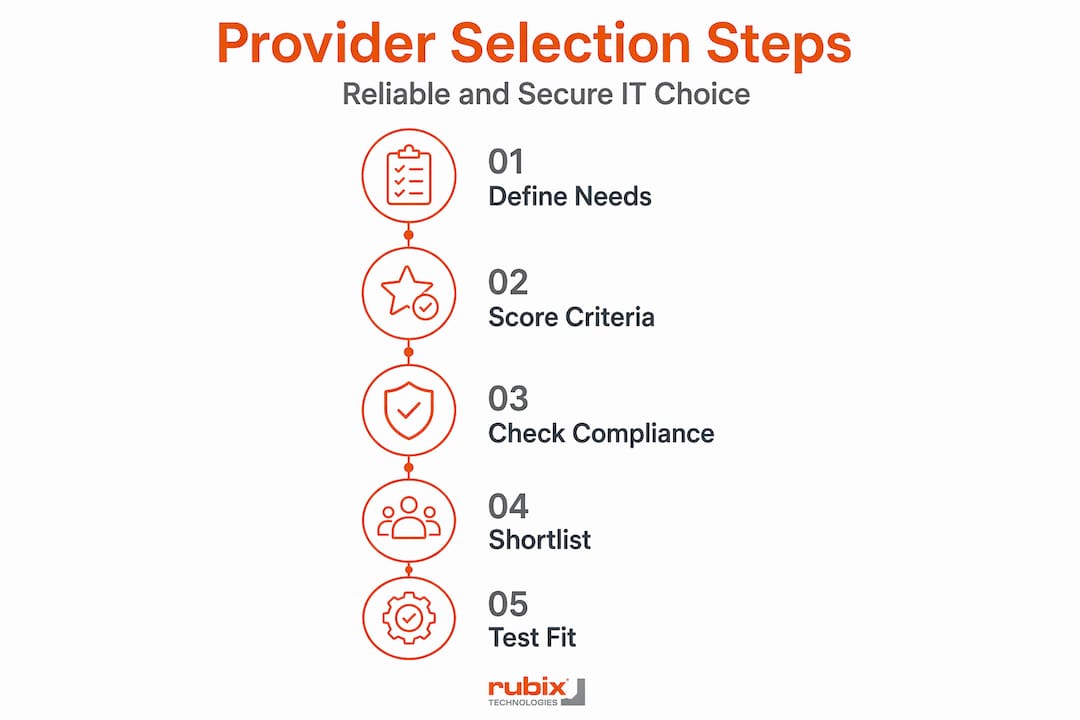
Build a shortlist using standardized evaluation criteria
Once your requirements are documented, the next challenge is comparing providers consistently. Without a structured approach, selection committees default to gut feel, relationships, or the most polished proposal deck. None of these correlate reliably with operational performance.
The solution is a weighted scoring matrix. Assign numerical weights to your most critical criteria based on business priority. A financial firm might weight regulatory compliance at 30%, cybersecurity capability at 25%, SLA performance at 20%, and price at 15%. An engineering firm might shift weight toward uptime and cloud platform support. The point is that the weights reflect your risk profile, not a generic industry template.
Here is an example scoring matrix for South African mid-sized firms:
| Evaluation criterion | Weight | Provider A score | Provider B score | Provider C score |
|---|---|---|---|---|
| SLA response and resolution times | 25% | 8/10 | 6/10 | 9/10 |
| Regulatory compliance evidence | 20% | 7/10 | 9/10 | 8/10 |
| Business continuity and DR capability | 20% | 9/10 | 7/10 | 8/10 |
| Cybersecurity certifications | 15% | 8/10 | 8/10 | 7/10 |
| Pricing and contract flexibility | 10% | 7/10 | 8/10 | 6/10 |
| Local support presence | 10% | 9/10 | 6/10 | 8/10 |
This approach, combined with a structured IT services comparison, gives your selection committee a defensible, documented rationale for the final decision.
South African firms should also include several non-negotiable criteria in their evaluation:
- 24/7/365 support coverage with documented escalation paths, not just business-hours availability
- Defined MTTR (mean time to resolve) targets for critical incidents, written into the contract
- Availability percentages stated as acceptance criteria, not marketing claims
- Proof of local regulatory awareness, particularly for firms subject to POPIA, FSCA requirements, or sector-specific data handling rules
When assessing IT vendors for South African contexts, RFP standards for cybersecurity services frequently specify 24/7/365 coverage, MTTR targets, and availability percentages as hard evaluation criteria, not aspirational statements.
Pro Tip: Require evidence for every acceptance criterion. A provider claiming “24/7 support” should be able to show you shift schedules, on-call rosters, or a documented incident response log. Claims without evidence are worth nothing in a service disruption.
Check compliance, eligibility, and operational resilience
Many firms treat compliance as a formality to check off near the end of the selection process. This is backwards. Regulatory eligibility is a gate, not a scoring factor. If a provider fails minimum compliance requirements, they should not make the shortlist regardless of their technical capability or price.

For South African firms, particularly those in the financial and engineering sectors, vendor evaluation in procurement contexts includes eligibility gates such as registration on the National Treasury supplier database and compliance with supply chain management and preferential procurement regulations. These are minimum entry requirements, not bonus points.
Minimum eligibility checks should include:
- National Treasury supplier database registration for any provider bidding on public or semi-public sector work
- Valid tax clearance and B-BBEE status documentation
- Proof of professional indemnity and cyber liability insurance
- Evidence of POPIA compliance, including documented data processing agreements
- References from South African clients in a comparable sector and firm size
Beyond eligibility, operational resilience separates adequate providers from genuinely reliable ones. Use the table below as a starting framework:
| Requirement | Mandatory for financial firms | Mandatory for engineering firms | Optional |
|---|---|---|---|
| 24/7/365 SOC monitoring | Yes | Yes | No |
| Documented DR and BCP plan | Yes | Yes | No |
| On-site support capability | Yes | Recommended | Smaller firms |
| Penetration testing evidence | Yes | Recommended | No |
| Cloud backup and failover | Yes | Yes | No |
| Preferential procurement compliance | Yes | Yes | Depends on client |
The benefits of managed security services become especially clear when you map provider capabilities against these resilience requirements. Providers who can demonstrate operational resilience with documented evidence give you a much stronger foundation than those offering reassurances.
For a broader view on what separates strong providers from weak ones, the guide on choosing the right South African IT company covers sector-specific considerations in practical depth.
Shared-control and co-managed IT: what most miss
Here is something many IT selection guides do not explain well. The choice is not binary between full outsourcing and keeping everything in-house. Co-managed IT sits in between, and for firms with existing internal IT staff, it is often the smartest model available. But it comes with real risks if the responsibilities are not clearly defined from day one.
In a co-managed arrangement, effective collaboration with a provider works when your firm retains license, root, and admin control while the provider handles 24×7 monitoring, response actions, documentation, and change execution under your direction. This keeps strategic control with your team while offloading the operational burden.
Here is how responsibilities typically split in a well-structured co-managed model:
- Your team controls: license management, user provisioning, policy decisions, vendor relationships, and strategic IT direction
- Provider handles: 24×7 monitoring and alerting, incident response, patch management, backup verification, and change documentation
- Joint responsibility: escalation procedures, quarterly reviews, capacity planning, and security awareness
Understanding why business leaders choose co-managed IT often comes down to the need for operational depth without surrendering control. But the model fails when boundaries are unclear.
Watch for these red flags in any co-managed proposal:
- The provider wants admin or root access without a documented access control policy
- Reporting is vague or infrequent, with no scheduled review cadence
- Roles and responsibilities are described in general terms rather than a formal RACI (Responsible, Accountable, Consulted, Informed) matrix
- The firm has no clear exit process if the relationship ends
Pro Tip: Insist on retaining admin and license control at all times. Never allow a provider to hold the only credentials to your Microsoft 365 tenant, Azure environment, or any core business platform. This is the single most common mistake firms make when transitioning to a co-managed model, and recovering from it is expensive.
Firms looking at innovative IT solutions for professional services increasingly find that co-managed arrangements give them access to enterprise-grade security operations without the cost of building a full in-house SOC team.
Final selection: test for true operational fit, not just box-ticking
You have defined your requirements, built a weighted scoring matrix, verified compliance, and clarified the delivery model. Now comes the part most firms rush: actually validating the finalists against real operational performance.
“A provider’s proposal tells you who they want to be. Their incident history tells you who they actually are. Ask for both.”
Avoid surface-level security claims: the most useful questions for decision-makers focus on operational mechanics, including monitoring coverage, detection and response workflows, reporting cadence, remediation evidence, and how responsibilities split in shared-control arrangements.
Use this process to move from shortlist to signed contract:
- Send a structured due diligence questionnaire to each finalist covering monitoring coverage, escalation workflows, incident response timelines, and reporting formats.
- Request documented evidence for SLA claims, including actual incident logs (anonymised if necessary), past MTTR data, and uptime reports from existing clients.
- Conduct reference checks with clients of comparable size and sector. Ask specifically about how the provider performed during a real incident, not just in normal operations.
- Negotiate SLAs as enforceable targets. Response and resolution times should function as acceptance criteria in the contract, with defined penalties or credits for non-performance.
- Clarify exit terms before signing. Confirm data portability, transition assistance, and knowledge transfer requirements in writing.
Key questions to ask every finalist:
- What is your documented MTTR for critical incidents, and can you show us historical performance data?
- How do you detect a breach that does not trigger a known signature? Walk us through the workflow.
- What does your escalation path look like at 2am on a Sunday?
- How often do you provide operational reports, and what do they contain?
- Can you share a case study where something went wrong and explain how you resolved it?
Learning more about what managed IT services actually deliver helps frame these questions effectively. For firms operating in a complex threat environment, reviewing South African cybersecurity considerations provides important context for what your provider should realistically be prepared to handle.
The uncomfortable truth most IT selection guides miss
Here is what most frameworks do not say directly. Every credible provider on your shortlist will have documentation. Most will have certifications. Many will have impressive-looking proposal decks. On paper, they will look nearly identical. The real differentiator does not show up in a scoring matrix.
What separates genuinely capable providers from adequate ones is how they behave under pressure. Incident communication quality. Ownership of mistakes. Speed of escalation when a situation exceeds the first responder’s capability. These things are nearly impossible to evaluate from a proposal document.
The instinct many decision-makers have is to select the provider with the most polished documentation. This is exactly backwards. Polished documentation is a marketing skill. Operational resilience is an engineering and process skill. They are not the same thing, and firms that confuse the two end up renewing contracts out of sunk cost rather than genuine satisfaction.
Our approach to in-depth vendor assessment consistently shows that the firms most satisfied with their IT providers are those who pushed hard during selection for real operational stories, not capability statements. Ask for a case where the provider failed to meet an SLA and what they did next. A provider who answers this question confidently and specifically is demonstrating accountability. A provider who deflects or claims it has never happened is demonstrating a risk you do not want to take on.
The framework in this guide is rigorous, but it is still just a framework. Use it as a floor, not a ceiling.
Looking for a reliable IT provider?
If this guide has helped clarify what you should be demanding from an IT provider, the next step is straightforward. Techtron offers both fully managed and co-managed IT services designed specifically for engineering and financial firms with 20 to 300 staff across South Africa. From proactive cybersecurity and SOC monitoring to backup, disaster recovery, Microsoft 365, and Azure management, every service is built around measurable SLAs and operational accountability. Explore what managed IT services can look like for your firm, or contact the Techtron team directly to discuss your specific requirements.
Frequently asked questions
What are the essential criteria for choosing an IT provider in South Africa?
Focus on measurable SLAs, regulatory compliance, operational continuity, and cyber capability. Score vendors on fit across service scope, SLA evidence, operational resilience, and incident response depth before comparing price.
Why is MTTR important in IT provider contracts?
MTTR (mean time to resolve) sets an enforceable benchmark for how quickly your provider must fix critical incidents, directly reducing your downtime exposure. South African RFPs for cybersecurity treat MTTR targets as hard acceptance criteria, not aspirational goals.
What is a co-managed IT service model?
A co-managed IT model lets your firm retain admin and license control while the provider delivers 24×7 monitoring and response under your direction. It gives you operational depth without surrendering strategic control.
How can I verify a provider’s legal eligibility for financial or engineering firms in South Africa?
Confirm they are registered on the National Treasury supplier database and hold valid compliance documentation. Vendor pre-qualification in South Africa routinely includes supply chain management and preferential procurement compliance as gate criteria.
What questions should I ask to avoid a box-ticking provider?
Ask how detection and response workflows operate, request historical MTTR data, and demand proof of regular monitoring. Decision-useful supplier questions focus on operational mechanics and how responsibilities split in shared-control arrangements, not marketing claims.