

Understanding the Benefits of IT Outsourcing
Most businesses are searching for ways to manage complex tech without blowing the budget. Turns out, 80 percent of Fortune 500 companies rely on IT outsourcing to keep their operations running smoothly while staying lean. That is surprising enough, but the real shock is that outsourcing is no longer just about saving money. It has become a powerful move to spark innovation and unlock global talent you never thought was within reach.
Table of Contents
- What Is It Outsourcing And Its Core Concepts?
- Why IT Outsourcing Matters For Businesses Today
- How IT Outsourcing Works In Practical Terms
- Key Benefits Of IT Outsourcing Explained
- Real-World Examples Of Successful IT Outsourcing
Quick Summary
| Takeaway | Explanation |
|---|---|
| IT outsourcing enhances operational efficiency | By outsourcing IT functions, companies can reduce management overhead and focus on core strategic goals. |
| Access to expert resources without big investments | Outsourcing allows firms to leverage specialized knowledge and technology without substantial capital expenses in hiring and training. |
| Flexible IT solutions adapt to market changes | Companies can scale IT capabilities quickly through outsourcing, allowing them to respond effectively to evolving business demands. |
| Predictable costs improve budget management | Shifting from capital expenditures to operational expenses helps organizations better plan and allocate financial resources. |
| Strategic partnerships drive innovation | Collaborating with professional IT service providers fosters innovation and enhances competitive advantage across industries. |
What is IT Outsourcing and its Core Concepts?
IT outsourcing represents a strategic approach where businesses contract external service providers to manage specific technology functions and infrastructure. According to Gartner Research, this practice allows companies to leverage specialized expertise while optimizing operational efficiency and reducing technology management overhead.
Understanding the Fundamental Concept
At its core, IT outsourcing involves transferring selected technology responsibilities to third-party providers who possess advanced technical capabilities and domain expertise. Organizations typically outsource functions such as:
- Network infrastructure management
- Cybersecurity monitoring
- Cloud computing services
- Software development
- Technical support and helpdesk operations
By partnering with external specialists, businesses can focus their internal resources on primary strategic objectives while ensuring robust technological performance. Check out our guide on managed IT services to explore how these solutions transform operational capabilities.
Strategic Implications for Modern Businesses
Modern enterprises recognize IT outsourcing as more than a cost-cutting mechanism. It represents a sophisticated approach to accessing global talent, advanced technological capabilities, and scalable solutions. Professional service providers bring standardized processes, cutting-edge technologies, and specialized knowledge that might be challenging or expensive to develop internally.
The strategic value emerges from gaining access to expert resources without substantial long-term investments in recruitment, training, and infrastructure. Companies can rapidly adapt their technological capabilities, respond to market changes, and maintain competitive advantage through flexible, expert-driven IT support models.
Why IT Outsourcing Matters for Businesses Today
In an increasingly digital world, IT outsourcing has transformed from a tactical cost-saving strategy to a critical business enabler. McKinsey & Company highlights that modern organizations view technological partnerships as essential for maintaining competitive advantage and driving operational innovation.
Addressing Contemporary Business Challenges
Businesses face unprecedented technological complexity and rapid digital transformation. IT outsourcing provides a strategic solution by offering:
- Immediate access to specialized technological expertise
- Flexible scaling of technological capabilities
- Reduced operational risks
- Enhanced cybersecurity infrastructure
- Cost-effective technology management
Global talent access becomes particularly crucial, enabling companies to leverage top-tier technological skills without extensive recruitment processes. Read more about our small business IT service solutions to understand how tailored outsourcing strategies can transform your technological infrastructure.
Financial and Strategic Advantages
Outsourcing IT functions enables businesses to convert substantial capital expenditures into predictable operational expenses.
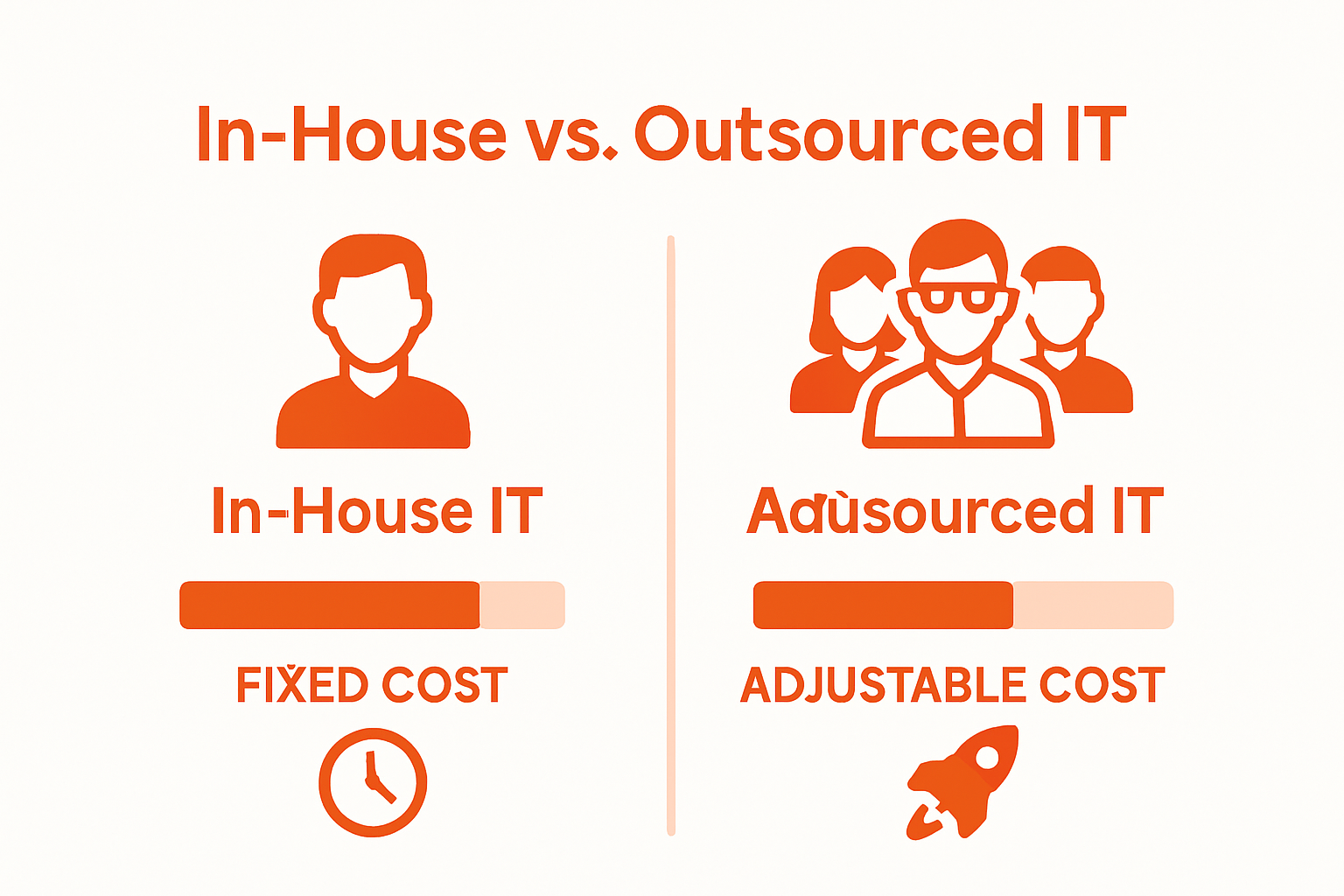 Rather than investing heavily in infrastructure, training, and continuous technological upgrades, organizations can redirect financial resources toward core business growth strategies.
Professional IT service providers bring standardized processes, advanced technological frameworks, and comprehensive risk management approaches that individual companies might struggle to develop internally. This approach allows businesses to remain agile, responsive, and technologically competitive without maintaining extensive in-house technological departments.
How IT Outsourcing Works in Practical Terms
IT outsourcing operates through structured partnerships that translate technological requirements into actionable service agreements. Deloitte Research emphasizes that successful outsourcing hinges on clear communication, well-defined expectations, and strategic alignment between businesses and technology providers.
Engagement and Service Models
Organizations can choose from multiple outsourcing frameworks depending on their specific technological needs and strategic objectives:
- Staff Augmentation: Supplementing internal teams with external specialists
- Managed Services: Comprehensive technology management by external providers
- Project-based Outsourcing: Targeted technological solution development
- Cloud Infrastructure Management: External management of cloud environments
- Cybersecurity Outsourcing: Specialized security monitoring and protection
Learn more about comparing IT service costs to understand the financial implications of different engagement models.
Implementation and Integration Process
The practical implementation of IT outsourcing involves several critical stages. Initially, businesses conduct comprehensive technological audits to identify potential outsourcing opportunities. Providers then develop customized service proposals addressing specific organizational requirements, infrastructure challenges, and strategic goals.
Successful integration demands robust communication protocols, clearly defined service level agreements (SLAs), and continuous performance monitoring. Technology partners collaborate closely with internal stakeholders to ensure seamless workflow, minimal operational disruption, and alignment with broader business objectives.
The following table gives a concise comparison of the main IT outsourcing engagement and service models discussed in the article to assist businesses in selecting the most suitable approach for their needs.
| Engagement Model | Description | Typical Use Case |
|---|---|---|
| Staff Augmentation | Bringing in external specialists to support internal teams | Bridging skill gaps for specific projects |
| Managed Services | Ongoing technology management by an external provider | Full IT management and support |
| Project-based Outsourcing | Engaging a provider for a specific, time-bound solution | Software/app development |
| Cloud Infrastructure Mgmt | Outsourcing management of cloud environments | Cloud migration and maintenance |
| Cybersecurity Outsourcing | Specialist provider manages security and compliance functions | Strengthening cyber resilience |
Key Benefits of IT Outsourcing Explained
IT outsourcing delivers transformative advantages that extend far beyond simple cost reduction. According to PwC Global Technology Insights, strategic technology partnerships enable businesses to unlock substantial operational and competitive advantages.
Strategic Operational Advantages
Organizations gain multiple critical benefits through professional IT outsourcing:

- Accelerated Innovation: Access to cutting-edge technological expertise
- Risk Mitigation: Comprehensive cybersecurity and compliance management
- Resource Optimization: Redirecting internal talent toward core business objectives
- Scalability: Flexible technological infrastructure that adapts to business needs
- Cost Efficiency: Predictable technology expenditure models
Technological flexibility emerges as a paramount benefit, allowing businesses to rapidly respond to market changes without substantial internal infrastructure investments. Explore our insights on IT cost management to understand how strategic outsourcing transforms financial planning.
Long-term Business Transformation
Beyond immediate operational improvements, IT outsourcing facilitates profound organizational evolution. Professional technology partners bring standardized processes, advanced frameworks, and specialized knowledge that transcend traditional internal capability limitations.
By partnering with expert technology providers, businesses can concentrate on core competencies while maintaining robust, secure, and innovative technological infrastructure. This approach transforms IT from a cost center into a strategic enabler of business growth, innovation, and competitive differentiation.
This table outlines the key strategic and operational benefits associated with IT outsourcing as highlighted in the article, offering readers a clear view of the value drivers.
| Benefit | Explanation |
|---|---|
| Accelerated Innovation | Gain fast access to global expertise and newest technologies |
| Risk Mitigation | Enhance cybersecurity and compliance management through specialist providers |
| Resource Optimisation | Allow internal teams to focus on core business objectives |
| Scalability | Flexibly adapt technology infrastructure to business needs |
| Cost Efficiency | Benefit from predictable and optimised expenditure on IT services |
| Technological Flexibility | Rapidly respond to market changes without large internal investments |
Real-World Examples of Successful IT Outsourcing
Gartner Research reveals that strategic IT outsourcing has transformed how global enterprises manage technological infrastructure, demonstrating tangible benefits across multiple industry sectors. Successful implementations showcase the potential of well-executed technological partnerships.
Enterprise-Level Transformation Strategies
Large organizations have leveraged IT outsourcing to achieve significant operational improvements:
- WhatsApp: Utilized external developers to build initial platform, reducing development costs
- Slack: Outsourced initial product development to design agency
- Google: Routinely outsources software development and technical support functions
- Alibaba: Engaged external technology partners for global expansion
- GitHub: Relied on distributed development teams across multiple geographies
Technology agility becomes evident in these examples, where companies strategically deploy external expertise to accelerate innovation. Read our detailed guide on small business IT service strategies to understand how similar approaches can benefit organizations of all sizes.
Strategic Outsourcing Implementation
Successful IT outsourcing requires meticulous planning and alignment with organizational objectives. Companies that excel in outsourcing focus on clear communication, well-defined project scopes, and continuous performance monitoring. By treating external technology partners as strategic collaborators rather than mere service providers, businesses can transform technological challenges into competitive advantages, driving innovation and operational efficiency across complex digital landscapes.
Turn IT Outsourcing Insights Into Real Growth for Your Business
Are you tired of juggling complex IT systems or struggling with resource constraints, as discussed in our article on IT outsourcing? Many South African firms face increasing pressure to manage cybersecurity risks, maintain compliance, and keep systems running smoothly while scaling their operations. If this sounds familiar, you are not alone. The real challenge is transforming IT from a daily technical burden into a powerful tool for business growth.
Let your business thrive by partnering with an expert IT team trusted by leading engineering and financial firms. At Techtron, we take managed IT services to the next level, offering proactive support, robust cybersecurity, cloud integration, and business continuity you can rely on. Explore our comprehensive solutions and testimonials to discover how we help mid-sized companies turn IT outsourcing benefits into lasting results. Ready to experience seamless operations and strengthened security? Visit Techtron today and connect with our specialists for a tailored, risk-free assessment of your IT needs.
Frequently Asked Questions
What is IT outsourcing?
IT outsourcing is a strategic approach where businesses contract external service providers to manage specific technology functions and infrastructure, allowing companies to focus on core business objectives.
What are the core benefits of IT outsourcing?
The main benefits include access to specialized expertise, cost efficiency, risk mitigation, scalability, and improved cybersecurity infrastructure.
How does IT outsourcing improve operational efficiency?
By transferring technology responsibilities to expert providers, companies can optimize resources, reduce management overhead, and leverage advanced processes and technologies, resulting in enhanced performance.
What are common IT functions that companies outsource?
Businesses often outsource various functions such as software development, cloud computing services, cybersecurity monitoring, technical support, and network infrastructure management.