

Virtualisation for Business – Impact on IT Operations
Over eighty percent of South African companies now rely on virtualisation to improve IT performance and cut costs. As digital demands rise, managing resources efficiently has become critical for business growth. Understanding how virtualisation changes computing not only saves money but also gives companies more flexibility and control over their technology. This guide highlights the strategies, types, and practical benefits that South African businesses are using to lead in a competitive market.
Key Takeaways
| Point | Details |
|---|---|
| Virtualisation Enhances Efficiency | By allowing multiple operating systems to run on a single server, virtualisation maximises resource utilisation and reduces overall infrastructure costs. |
| Key Types of Virtualisation | Server, network, storage, and desktop virtualisation offer tailored solutions for diverse technological needs and improve overall IT agility. |
| Operational Advantages | Businesses benefit from improved scalability, cost efficiency, and enhanced security through the use of virtualised environments. |
| Management Challenges | Implementing virtualisation requires meticulous planning and expert management to navigate potential risks such as performance bottlenecks and security vulnerabilities. |
What Virtualisation Means in Modern IT
Virtualisation represents a transformative approach in contemporary information technology, enabling businesses to reimagine how computational resources are deployed and managed. At its core, virtualisation creates software-based representations of physical computing components, allowing multiple operating systems and applications to run efficiently on a single physical server.
The fundamental concept involves creating software-based representations of servers, applications, and networks that operate independently from underlying hardware infrastructure. This technological strategy enables organisations to maximise resource utilisation, simplify management processes, and enhance overall computational performance. By abstracting hardware capabilities, businesses can run multiple virtual machines simultaneously, reducing physical infrastructure requirements and operational expenses.
Modern virtualisation strategies extend across several critical domains:
- Server Virtualisation: Enables multiple virtual servers to operate on a single physical machine
- Network Virtualisation: Allows complex network configurations to be managed through software
- Storage Virtualisation: Consolidates storage resources from multiple devices into a centralised management system
- Desktop Virtualisation: Provides flexible access to computing environments across different devices
Businesses implementing virtualisation can expect significant operational advantages. Organisations can run multiple virtual machines on a single physical server, maximising resource utilisation and simplifying management, which translates into improved efficiency, reduced infrastructure costs, and enhanced scalability. The ability to quickly provision, migrate, and manage computing resources represents a substantial technological leap from traditional hardware-dependent computing models.
Types of Virtualisation Used by Businesses
Virtualisation technology has evolved to encompass multiple domains, offering businesses flexible and efficient computing solutions. Virtualisation now spans applications, servers, storage, and networks, enabling complex operational capabilities, transforming traditional IT infrastructure management approaches.
Businesses typically implement several key types of virtualisation to optimise their technological ecosystems:
- Server Virtualisation
- Divides physical server resources into multiple virtual servers
- Allows multiple operating systems to run simultaneously
- Improves hardware utilisation and reduces infrastructure costs
- Network Virtualisation
- Combines network resources into a single, software-based administrative platform
- Enables more flexible network configuration and management
- Enhances security and reduces hardware dependency
- Storage Virtualisation
- Consolidates physical storage from multiple devices into a unified system
- Simplifies data management and improves storage allocation
- Provides greater flexibility in data storage and retrieval
- Desktop Virtualisation
- Creates virtual desktop environments accessible from multiple devices
- Centralises desktop management and security
- Supports remote work and flexible computing strategies
Each virtualisation type offers unique advantages, allowing organisations to create more agile, scalable, and cost-effective IT infrastructures. By strategically implementing these technologies, businesses can dramatically improve resource allocation, reduce operational complexities, and enhance overall technological performance.
How Virtualisation Works in Practice
Virtualisation fundamentally transforms computing infrastructure through a sophisticated software layer that abstracts and decouples computational resources from physical hardware. Virtualisation operates through virtual machines, which are isolated software containers containing complete operating systems and applications, managed by an intermediary software called a hypervisor.
The hypervisor plays a critical role in the virtualisation process, acting as a sophisticated management layer that enables multiple virtual machines to coexist and operate independently on a single physical server. This technology allows for precise resource allocation, ensuring that each virtual machine receives the computational power, memory, and storage it requires without interference from other virtual environments.
Practical implementation of virtualisation involves several key operational mechanics:
- Resource Partitioning: Dividing physical server capabilities into discrete, manageable virtual environments
- Isolation: Ensuring each virtual machine operates independently and securely
- Dynamic Allocation: Flexibly redistributing computational resources based on real-time requirements
By running multiple virtual machines on a single physical server, businesses can dramatically maximise resource utilisation, simplify management processes, and enhance overall system performance. The result is a more efficient, scalable, and cost-effective computing infrastructure that allows organisations to adapt quickly to changing technological demands while maintaining robust security and operational integrity.
Key Advantages and Business Benefits
Virtualisation represents a transformative technology that delivers substantial strategic advantages for modern businesses. Organisations can significantly improve hardware resource utilisation, enhance operational flexibility, and simplify complex management processes, creating a more responsive and efficient technological ecosystem.
The primary business benefits of virtualisation extend across multiple critical operational dimensions:
- Cost Efficiency: Reduces hardware infrastructure expenses
- Resource Optimisation: Maximises computational capacity
- Scalability: Enables rapid technological adaptation
- Improved Security: Provides enhanced isolation between computing environments
Virtualisation increases operational efficiency by streamlining processes and reducing resource waste, ensuring businesses can maintain continuous, flexible technological capabilities. By decoupling software from hardware, organisations gain unprecedented agility in managing their technological infrastructure, allowing for faster deployment, easier maintenance, and more dynamic resource allocation.
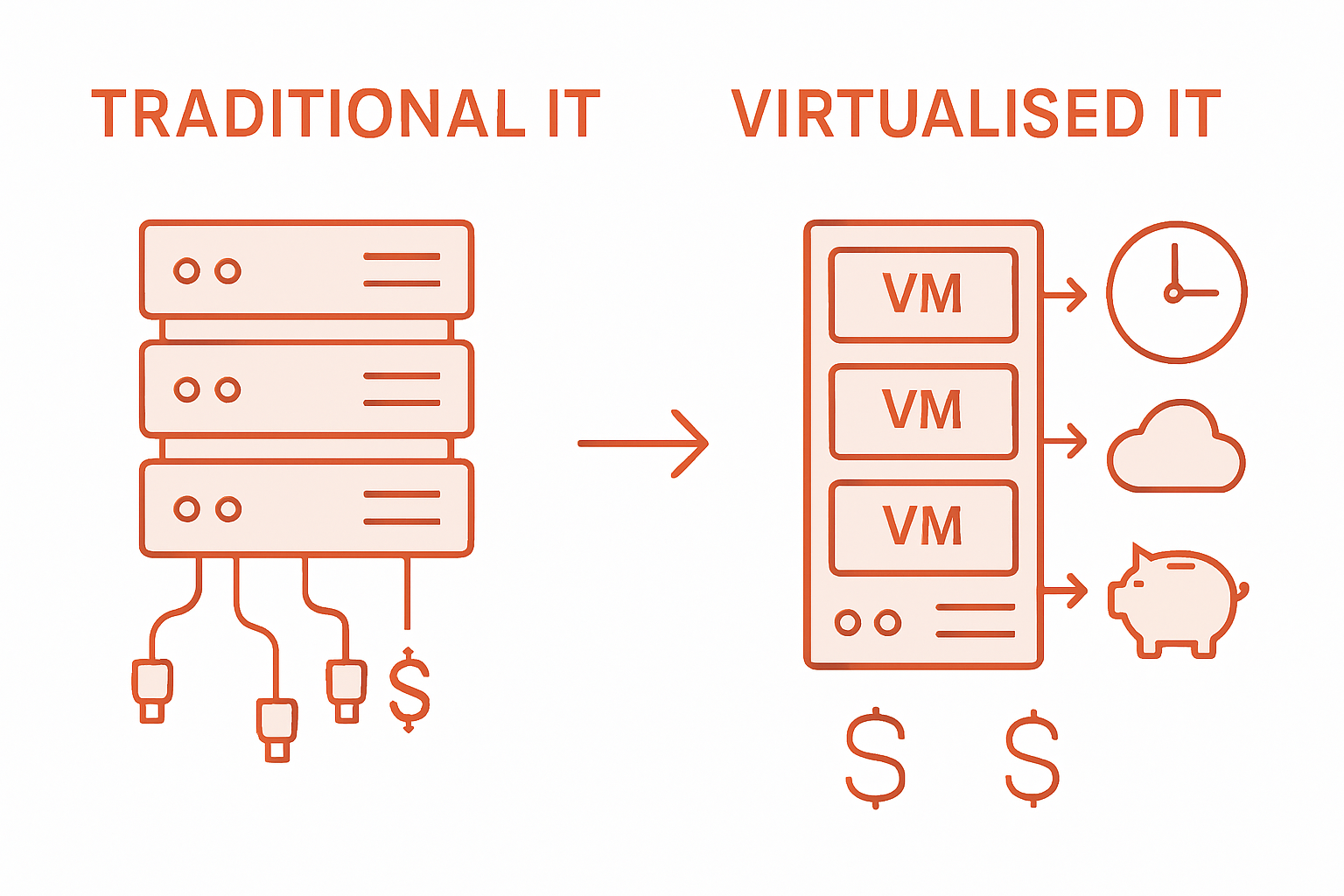
Businesses implementing virtualisation can expect transformative outcomes, including reduced capital expenditure, improved disaster recovery capabilities, and the ability to support complex hybrid and multi-cloud environments. The technology empowers organisations to create more resilient, adaptable IT infrastructures that can quickly respond to changing technological and market demands.
Risks, Costs, and Common Pitfalls
Virtualisation, while offering substantial technological advantages, presents complex challenges that organisations must carefully navigate. Enterprises must understand that optimising server hardware utility introduces inherent complexities requiring meticulous management, demanding strategic planning and expert implementation.
Key risks and potential pitfalls in virtualisation implementation include:
- Performance Bottlenecks: Potential resource contention between virtual machines
- Licensing Complications: Complex software licensing requirements
- Security Vulnerabilities: Increased attack surface across virtual environments
- Management Overhead: Sophisticated monitoring and maintenance needs
Traditional storage systems not designed for virtualised environments can create significant inefficiencies and escalate operational costs, representing a critical consideration for businesses transitioning to virtualised infrastructure. Storage management emerges as a fundamental challenge, where inappropriate architectures can dramatically undermine the anticipated benefits of virtualisation.
Successful virtualisation strategies demand comprehensive risk assessment, ongoing performance monitoring, and a proactive approach to technological integration. Organisations must invest in specialised skills, robust management tools, and continuous training to mitigate potential operational disruptions and maximise the transformative potential of virtualised computing environments.
Unlock the Full Potential of Virtualisation with Expert IT Management
The article highlights the complexity and powerful benefits of virtualisation, including maximising hardware resource utilisation, enhancing scalability, and improving operational efficiency. Yet with these advantages come real challenges such as managing performance bottlenecks, security vulnerabilities, and storage inefficiencies. Organisations often face the difficult task of balancing these factors while striving for seamless IT operations.
At Techtron, we understand how critical it is to get virtualisation right. We specialise in providing fully managed IT services tailored to meet the unique demands of professional service firms. Our expert team will help you harness virtualisation technologies through proactive infrastructure management, robust cybersecurity, and cloud integration solutions that reduce complexity and safeguard your business continuity. Let us ease your technical burdens and provide the scalable, secure IT foundation your business needs today.
Don’t let virtualisation risks slow your growth. Discover how our managed IT services can optimise your IT environment for performance and security. Take action now to improve your virtualisation outcomes with expert support tailored to your business—contact Techtron and move towards a future-proof IT operation.
Frequently Asked Questions
What is virtualisation in IT operations?
Virtualisation is a technology that allows businesses to create software-based representations of physical computing resources, enabling multiple operating systems and applications to run on a single physical server.
What are the key types of virtualisation used by businesses?
The key types include server virtualisation, network virtualisation, storage virtualisation, and desktop virtualisation, each providing unique benefits like improved resource utilisation and simplified management.
What are the main advantages of implementing virtualisation?
Implementing virtualisation can lead to cost efficiency, optimal resource utilisation, enhanced scalability, and improved security by providing isolation between different computing environments.
What risks are associated with virtualisation?
Risks include performance bottlenecks, licensing complications, security vulnerabilities, and management overhead that can challenge the implementation and operation of virtualised environments.