

What Is Endpoint Management and Why It Matters
More than 60 percent of South African companies struggle to keep pace with threats from unmanaged devices. Rising cyber risks and operational complexity leave many mid-sized engineering and financial firms searching for better control over their endpoints. This article reveals practical strategies to simplify device management, strengthen security protocols, and boost business resilience for South African organisations facing a rapidly evolving digital environment.
Key Takeaways
| Point | Details |
|---|---|
| Effective Endpoint Management | Centralised control of devices enhances security and reduces operational costs for South African businesses. |
| Diverse Device Support | Endpoint management must accommodate a variety of devices, including desktops, laptops, smartphones, and IoT devices. |
| Core Security Functions | Consistent policies, patch management, and threat detection are essential for maintaining a secure technological environment. |
| Robust Compliance Strategy | Businesses must ensure their endpoint management strategies meet regulatory standards to avoid compliance risks. |
Defining Endpoint Management for Businesses
Endpoint management represents a strategic approach for organisations to centrally monitor, secure, and control all digital devices connected to their network. In the South African business context, this means creating a comprehensive system that addresses the complexities of managing laptops, smartphones, tablets, and other workplace technologies. Unified endpoint management platforms enable businesses to streamline device governance across diverse technological ecosystems.
At its core, endpoint management involves several critical functions that protect and optimise an organisation’s technological infrastructure. These functions include device provisioning, software deployment, security policy enforcement, and continuous monitoring. Companies can centralise control mechanisms, reducing fragmentation and lowering operational costs while maintaining robust cybersecurity protocols. Endpoint management strategies have become increasingly important as organisations embrace hybrid work models and distributed technological environments.
The primary objectives of effective endpoint management extend beyond simple device tracking. They encompass comprehensive security, compliance enforcement, and operational efficiency. South African businesses must consider key capabilities such as:
- Remote device configuration and updates
- Automated patch management
- Threat detection and response
- Policy enforcement across different device types
- Secure application delivery
Pro tip: Implement a robust endpoint management strategy that includes regular security audits and comprehensive device lifecycle tracking to minimise vulnerabilities and optimise technological resources.
Types of Endpoints and Device Coverage
In the modern South African business landscape, endpoint management encompasses a diverse range of technological devices that organisations must monitor and secure. This includes traditional computing equipment like desktop computers and laptops, as well as mobile devices such as smartphones and tablets. The complexity of managing these varied endpoints has increased dramatically with the rise of hybrid work environments and bring-your-own-device (BYOD) policies.
Device categories in contemporary endpoint management strategies typically include:
- Desktop computers running Windows, macOS, and Linux
- Laptops for mobile workforce requirements
- Smartphones (iOS and Android)
- Tablets and convertible devices
- IoT devices and specialised hardware
- Servers and cloud-connected systems
South African enterprises face unique challenges in managing this heterogeneous technological ecosystem. The diversity of operating systems, device types, and connection methods requires sophisticated endpoint management solutions that can provide comprehensive visibility and control. Modern organisations must implement strategies that can seamlessly integrate different device types while maintaining robust security protocols.

Each device type presents distinct management requirements, necessitating flexible and adaptive endpoint management approaches. Mobile devices, for instance, demand different security configurations compared to desktop systems, while IoT devices introduce additional complexity with their specific network and security needs.
Here’s a quick comparison of device types and what makes their endpoint management unique in South African businesses:
| Device Category | Unique Management Challenge | Typical Security Priority |
|---|---|---|
| Desktop/Laptop | Diverse operating systems | Patch and policy enforcement |
| Smartphones/Tablets | Mobility and frequent network changes | Data encryption and remote wiping |
| IoT Devices | Limited processing power | Network isolation and access control |
| Servers/Cloud Systems | Critical data and app hosting | Continuous monitoring and rapid patching |
Pro tip: Develop a comprehensive device inventory and classification system that maps all endpoint types, their access levels, and specific security requirements to simplify your management strategy.
Core Functions and Security Processes
Endpoint management incorporates a comprehensive set of core security and operational functions designed to protect and optimise organisational technological infrastructure. These functions go beyond simple device monitoring, encompassing sophisticated strategies for preventing, detecting, and responding to potential security threats across an organisation’s entire digital ecosystem.
The primary core functions of endpoint management include:
- Device Discovery: Identifying and cataloguing all network-connected devices
- Patch Management: Ensuring all systems are updated with the latest security fixes
- Policy Enforcement: Implementing consistent security standards across all endpoints
- Remote Monitoring: Tracking device performance and potential security anomalies
- Threat Detection: Identifying and mitigating potential security risks
South African businesses are increasingly adopting advanced endpoint security strategies that integrate AI-enhanced Endpoint Detection and Response (EDR) and Extended Detection and Response (XDR) systems. These sophisticated approaches provide behaviour-based threat detection and comprehensive visibility into potential security incidents, enabling organisations to respond rapidly and effectively to emerging cyber threats.
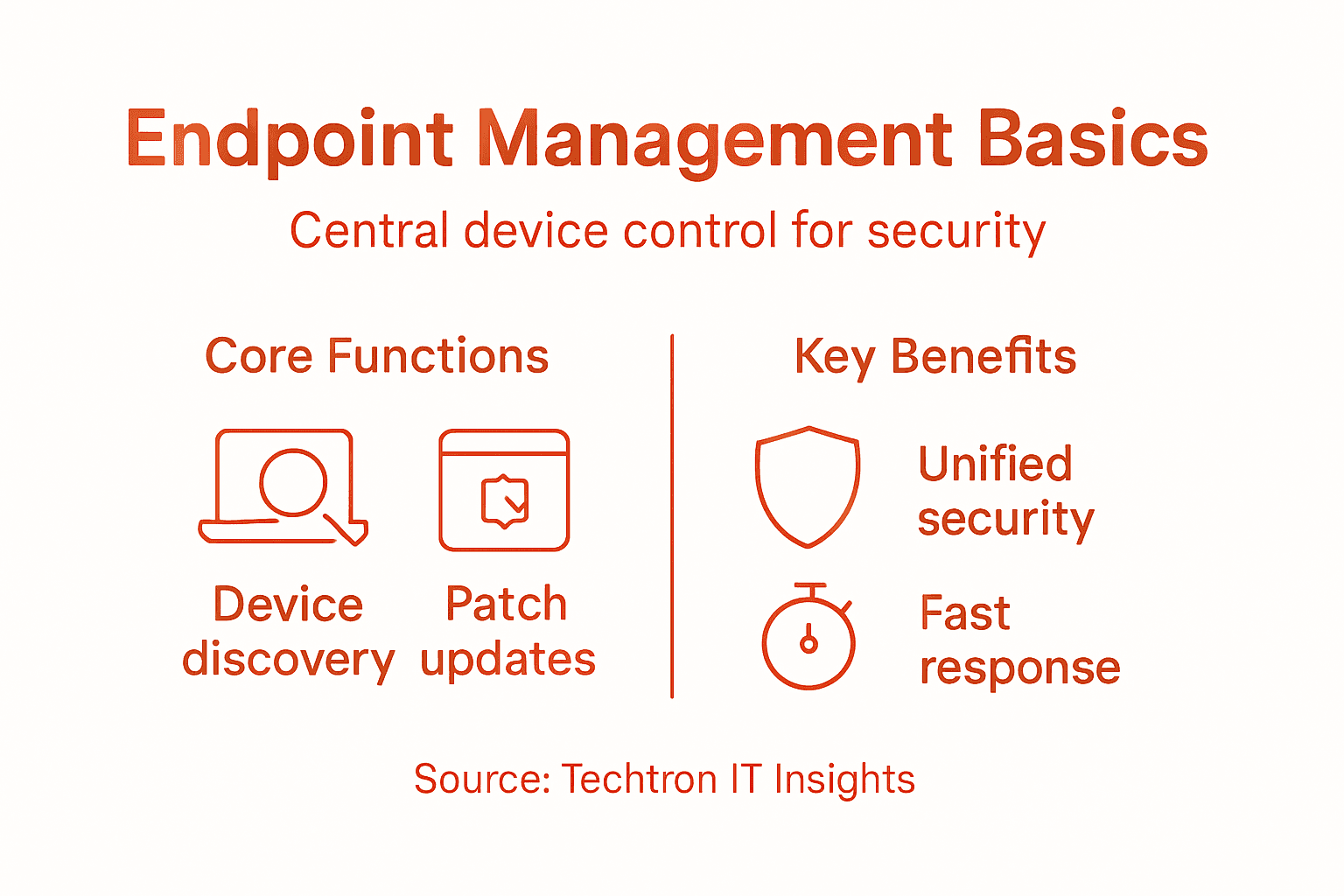
The security processes in modern endpoint management are designed to create a multi-layered defence mechanism. This includes automated update systems, comprehensive threat monitoring, real-time incident response capabilities, and continuous security assessment. By implementing these robust processes, organisations can significantly reduce their vulnerability to cyber attacks and protect their critical digital assets.
Pro tip: Implement a continuous monitoring and assessment strategy that combines automated tools with regular human security audits to create a comprehensive and adaptive endpoint security approach.
Benefits for South African Companies
Endpoint management delivers transformative advantages for South African businesses, supporting hybrid and remote work models while addressing the unique technological challenges of our dynamic business landscape. By implementing comprehensive endpoint management strategies, organisations can achieve significant operational improvements and enhanced security posture across diverse industry sectors.
The key benefits for South African companies include:
- Improved IT Efficiency: Streamlining device management and reducing technical overhead
- Enhanced Security: Protecting critical business data against evolving cyber threats
- Cost Reduction: Minimising operational expenses through centralised management
- Compliance Management: Ensuring adherence to local and international regulatory standards
- Productivity Optimization: Enabling seamless workforce connectivity and device performance
Advanced endpoint security strategies have become particularly crucial for protecting critical sectors such as banking, mining, and government services. These strategies leverage AI-powered detection tools to provide proactive threat mitigation, allowing South African businesses to maintain resilience in an increasingly digital economy.
The comprehensive approach of endpoint management goes beyond traditional IT support, creating a robust framework that adapts to the complex technological ecosystem of modern South African enterprises. By integrating sophisticated monitoring, security, and management capabilities, companies can develop a more agile and responsive technological infrastructure.
Below is a summary of business benefits from robust endpoint management, mapped to real-world impact:
| Benefit | Real-World Impact |
|---|---|
| Improved IT Efficiency | Faster problem resolution and less downtime |
| Enhanced Security | Fewer security breaches or data leaks |
| Cost Reduction | Lower IT spend and resource requirements |
| Compliance Management | Reduced risk of regulatory fines |
| Productivity Optimisation | Employees work seamlessly, from any location |
Pro tip: Conduct a comprehensive audit of your current endpoint infrastructure to identify potential vulnerabilities and develop a tailored endpoint management strategy that aligns with your specific business objectives.
Risks, Compliance, and Common Pitfalls
Endpoint management introduces complex challenges for South African businesses, with critical risks emerging from unmanaged technological environments. These risks range from potential security breaches to significant compliance vulnerabilities that can compromise an organisation’s entire digital infrastructure.
The most prevalent risks and pitfalls include:
- Uncontrolled Device Proliferation: Lack of visibility into network-connected devices
- Inconsistent Security Policies: Fragmented approach to endpoint protection
- Manual Management Processes: Inefficient and error-prone device configuration
- Regulatory Non-Compliance: Failing to meet industry-specific technological standards
- Inadequate Threat Detection: Limited capabilities to identify and respond to security incidents
South African organisations must develop robust strategies that address these challenges comprehensively. This requires implementing Unified Endpoint Management (UEM) and Digital Experience Management (DEM) frameworks that provide centralized control, consistent policy enforcement, and real-time monitoring capabilities. By adopting a proactive approach, businesses can mitigate risks and create a more secure technological ecosystem.
Compliance remains a critical consideration, particularly for industries handling sensitive data. Financial services, healthcare, and government sectors must navigate complex regulatory landscapes, ensuring that endpoint management strategies align with local and international standards. This demands a holistic approach that balances security, operational efficiency, and regulatory requirements.
Pro tip: Develop a comprehensive endpoint management policy that includes regular risk assessments, continuous monitoring, and adaptive security protocols to stay ahead of emerging technological challenges.
Strengthen Your Business with Expert Endpoint Management Solutions
Managing diverse digital devices across your organisation is crucial in today’s South African business environment. The challenges of remote device configuration, automated patch management and consistent policy enforcement demand proactive and comprehensive endpoint management to safeguard your data and ensure operational continuity. If you are seeking to reduce security risks while improving IT efficiency and compliance, understanding these core needs is the first step.
At Techtron, we specialise in delivering tailored managed IT services that address these exact challenges—offering fully managed and co-managed solutions designed to protect your endpoints and optimise your IT environment. Discover how our expertise in cybersecurity, network security and cloud integration can future-proof your business by visiting our landing page. Start protecting your digital infrastructure today and experience peace of mind with an IT partner built to support your growth.
Frequently Asked Questions
What is endpoint management?
Endpoint management is a strategic approach that allows organizations to centrally monitor, secure, and control all digital devices connected to their network. This includes managing laptops, smartphones, tablets, and other workplace technologies to enhance security and operational efficiency.
Why is endpoint management important for businesses?
Endpoint management is crucial as it improves IT efficiency, enhances security to protect against cyber threats, reduces operational costs through centralized management, and ensures compliance with regulatory standards. It also supports remote and hybrid work models, optimizing productivity.
What are the core functions of endpoint management?
The core functions include device discovery, patch management, policy enforcement, remote monitoring, and threat detection. These functions collectively work to prevent, detect, and respond to security threats across an organization’s digital ecosystem.
What are the common challenges in endpoint management?
Common challenges include uncontrolled device proliferation, inconsistent security policies, manual management processes, regulatory non-compliance, and inadequate threat detection capabilities. Addressing these requires a proactive approach to unify and streamline endpoint management strategies.