

Co-managed IT for businesses: the 2026 guide
TL;DR:
- Co-managed IT involves a partner sharing specific responsibilities with your internal team, maintaining knowledge inside your business. This model is ideal for mid-sized companies with limited IT staff, enhancing cybersecurity, operational hours, and scalability affordably. Clear scope matrices and regular reviews are essential for success, with pricing based on the domains the MSP manages, typically costing $60 to $150 per user monthly.
Co-managed IT is a shared service model where your internal IT team partners with an external managed service provider (MSP) to split defined responsibilities, giving you specialist coverage without handing over full control. Unlike fully outsourced IT, this model keeps institutional knowledge inside your business while filling the gaps your in-house team cannot cover alone. Approximately 60% of businesses now use managed or co-managed IT services to optimise costs and efficiency. For mid-sized South African companies with lean IT teams, co-managed IT for businesses is one of the most practical ways to strengthen cybersecurity, extend operational hours, and scale without a costly new hire.
Why co-managed IT suits mid-sized companies
The ideal fit for co-managed IT is a business with 50 to 500 employees and one to three internal IT staff. That profile describes a large portion of South Africa’s professional services sector, from engineering consultancies in Sandton to financial advisory firms in Cape Town.
A single IT manager carrying the full load faces predictable problems:
- Coverage gaps. One person cannot monitor threats at 2 AM and run a software rollout by 8 AM.
- Skill shortages. Cybersecurity, Microsoft Azure, and compliance work each require deep specialisation that generalists cannot maintain simultaneously.
- Burnout. Co-managed IT reduces burnout by offloading repetitive tasks and after-hours incidents from internal leads. Burnout is a retention risk, and replacing an IT manager in South Africa costs far more than the salary gap suggests.
- Regulatory pressure. South African businesses in finance and healthcare face POPIA compliance requirements, while export-facing firms may need to meet SOC 2 or CMMC standards. MSPs with compliance expertise can provide that specialisation without you building it internally.
Co-managed IT typically costs between $60 and $150 per user per month for mid-market companies with 50 to 200 employees. That range sits well below the total cost of a second full-time IT hire when you factor in salary, benefits, equipment, and training. The model lets your existing IT lead focus on strategic work while the MSP handles the operational load.
What does a co-managed IT service model look like?

Co-managed IT is not a single product. It is a spectrum of engagement types, and the right model depends on where your internal team is strongest and where the gaps are most exposed.
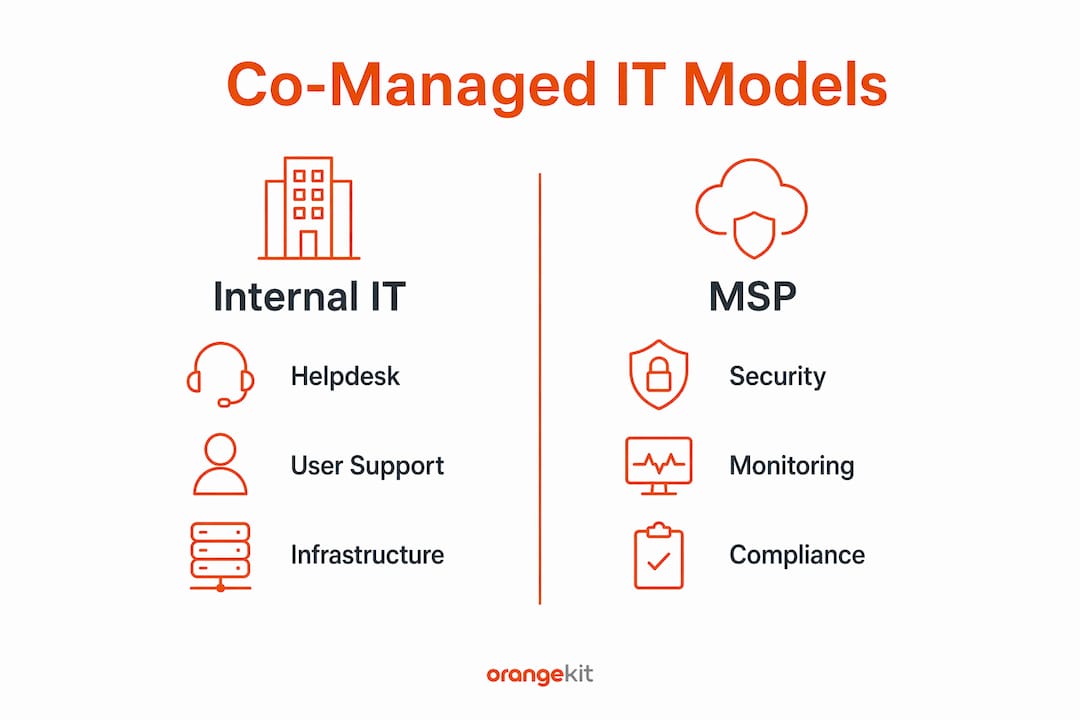
| Model | Internal IT owns | MSP owns | Best for |
|---|---|---|---|
| Security-led split | Helpdesk, user support | Cybersecurity, monitoring, patching | Companies with POPIA or SOC 2 obligations |
| After-hours augmentation | All daytime operations | After-hours monitoring and incident response | Businesses needing 24/7 coverage without shift work |
| Project and specialist support | Day-to-day operations | Complex migrations, Azure, cloud projects | Companies running infrastructure upgrades |
| Full domain split | Defined functional areas | Defined functional areas | Larger mid-market with structured IT functions |
The most important document in any co-managed arrangement is the scope matrix. A written scope matrix that defines clear responsibility domains is critical to avoiding service gaps and disputes. Without it, both teams assume the other is handling a problem, and incidents fall through the cracks.
Pro Tip: Before signing any co-managed IT agreement, map every IT function your business relies on and assign a clear owner. If a function has two owners, it effectively has none.
A healthy co-managed relationship also means the MSP reports to your internal IT lead, not around them. MSPs should support the internal IT lead while providing enterprise-grade tools and transparent reporting. This preserves authority and morale inside your team.
How is co-managed IT priced?
Pricing in co-managed IT reflects the scope of what the MSP owns, not a blanket discount off full managed services. Co-managed IT pricing is determined by the complexity and scope of owned domains. A company that hands over only after-hours monitoring pays far less than one that assigns cybersecurity, patching, and cloud management to the MSP.
When budgeting for a co-managed IT investment, consider these factors:
- Number of users and devices covered under the agreement
- After-hours and weekend coverage requirements, which carry a premium
- Specialist domains such as Microsoft 365 administration, Azure, or security operations
- Compliance obligations that require documented audit trails and reporting
- Tooling costs for platforms like Microsoft Defender, ConnectWise, or NinjaRMM that the MSP brings to the engagement
Co-managed IT often delivers better outcomes and cost savings compared to hiring a second internal IT staff member. For a South African business paying R600,000 to R900,000 per year for a mid-level IT hire, a co-managed arrangement covering equivalent scope frequently comes in lower while providing broader expertise and redundancy.
Pro Tip: Ask any MSP to break their quote down by domain. If they cannot, the pricing is not scoped correctly and you will face scope creep disputes later.
Implementing co-managed IT: best practices for South African businesses
Getting the model right from the start prevents the most common failure mode: two teams with overlapping mandates and no clear escalation path. Follow these steps when onboarding a co-managed IT partner.
- Document your current IT environment. Produce a full asset register, network diagram, and list of active software licences before the MSP starts. Good IT documentation practices prevent onboarding delays and knowledge gaps.
- Define the scope matrix in writing. Every IT function must have a named owner. Include escalation paths, response time expectations, and tooling responsibilities.
- Establish communication protocols. Decide how the MSP communicates with your internal lead, how incidents are logged, and who speaks to end users. Ambiguity here creates friction fast.
- Run a quarterly review. Quarterly reviews of domain splits keep the partnership aligned with evolving business and compliance needs. Your IT requirements in Q1 will not be identical to Q4, especially if you are growing or facing a regulatory audit.
- Protect institutional knowledge. Your internal IT lead knows your business. The MSP knows scale and tooling. Structure the relationship so that knowledge flows both ways, not just outward.
One area where South African mid-market companies often underinvest is post-acquisition integration. Co-managed IT supports M&A integration by standardising security and compliance without disrupting the acquired company’s institutional knowledge. If your business is growing through acquisition, a co-managed model gives you the flexibility to absorb new environments without overwhelming your internal team.
Key takeaways
Co-managed IT works best when responsibilities are clearly split, the MSP supports rather than replaces the internal IT lead, and the scope is reviewed regularly.
| Point | Details |
|---|---|
| Ideal company profile | Businesses with 50 to 500 employees and 1 to 3 IT staff benefit most from co-managed IT. |
| Scope matrix is non-negotiable | A written domain ownership document prevents service gaps, disputes, and burnout. |
| Pricing follows scope | Co-managed IT costs reflect owned domains, not a fixed discount off full managed services. |
| MSP supports, not replaces | The internal IT lead retains authority; the MSP provides tools, coverage, and specialist skills. |
| Quarterly reviews matter | Regular scope reviews keep the partnership aligned with compliance and business growth. |
What I have seen working with mid-market IT teams
The businesses that get co-managed IT right are not the ones with the biggest budgets. They are the ones that treat the MSP as a structured extension of their team rather than a vendor on call. I have seen arrangements collapse not because the MSP underperformed, but because nobody defined who owned what. The internal IT manager assumed the MSP was handling patching. The MSP assumed the client had it covered. A ransomware incident settled the argument.
The other pattern worth naming is the retention effect. When a single IT manager is no longer the only person standing between the business and a breach, they stay longer. They take leave. They think strategically instead of reactively. That is not a soft benefit. It is a measurable reduction in turnover risk for a role that is genuinely hard to replace in the South African market.
My caution to any decision-maker evaluating this model: do not choose an MSP based on price alone. Choose based on how clearly they can articulate what they will own, how they will report to your internal lead, and what their escalation process looks like at 11 PM on a Friday. If those answers are vague, the relationship will be too.
For more context on why this model is gaining traction locally, the strategic case for co-managed IT is worth reading before you start any vendor conversations.
— Steven
How Techtron supports co-managed IT in South Africa
Techtron works with mid-sized South African businesses that have existing IT staff and need structured external support to cover cybersecurity, after-hours monitoring, Microsoft 365 administration, and compliance. The model is built around your internal team, not around replacing it. Techtron provides the tooling, the 24/7 coverage, and the specialist expertise while your IT lead retains authority and strategic direction. If you are weighing whether co-managed IT fits your business, explore Techtron’s co-managed IT approach or use the in-house vs outsourced IT cost comparison to run the numbers before your next budget cycle.
FAQ
What is co-managed IT?
Co-managed IT is a model where an internal IT team and an external MSP share defined IT responsibilities. The split is documented in a scope matrix that assigns ownership of specific functions to each party.
How does co-managed IT differ from fully managed IT?
In fully managed IT, the MSP owns all IT functions. In co-managed IT, your internal team retains ownership of certain domains while the MSP covers the rest. Your IT lead remains the primary authority.
What does co-managed IT cost in South Africa?
Pricing typically ranges from $60 to $150 per user per month for mid-market companies, depending on the scope of domains the MSP owns. After-hours coverage and specialist services such as cybersecurity or Azure management increase the cost.
Is co-managed IT suitable for POPIA compliance?
Yes. MSPs with compliance expertise can own the documentation, monitoring, and reporting functions required under POPIA, while your internal team manages day-to-day user access and data governance.
How many IT staff do you need before co-managed IT makes sense?
The model works best for businesses with one to three internal IT staff. At that size, coverage gaps and skill shortages are most acute, and the cost of a second full-time hire is harder to justify than a scoped MSP arrangement.