

Preventing Data Loss with Effective IT Management
Every South African IT manager knows the stakes are high when it comes to protecting sensitive information and keeping operations running smoothly. With strict regulatory guidelines from South African financial authorities and the real risk of critical data loss highlighted by government IT audits, an effective data protection strategy is no longer optional. This guide brings practical steps for defending against security threats, ensuring backup readiness, and maintaining operational continuity that align with local compliance standards.
Quick Summary
| Key Insight | Explanation |
|---|---|
| 1. Conduct comprehensive data risk assessments | Regularly evaluate vulnerabilities across hardware, software, networks, and compliance to enhance security measures. |
| 2. Implement robust backup strategies | Establish automated and tiered backup solutions to ensure data recovery and business continuity in case of disruptions. |
| 3. Enforce strong access and authentication policies | Use multi-factor authentication and regular audits to maintain strict control over user access to sensitive information. |
| 4. Utilize proactive monitoring systems | Employ real-time monitoring tools to identify potential security threats before they escalate into major issues. |
| 5. Regularly verify data recovery readiness | Conduct systematic recovery tests to ensure operational resilience and swift restoration of critical systems when needed. |
Step 1: Assess current data risks comprehensively
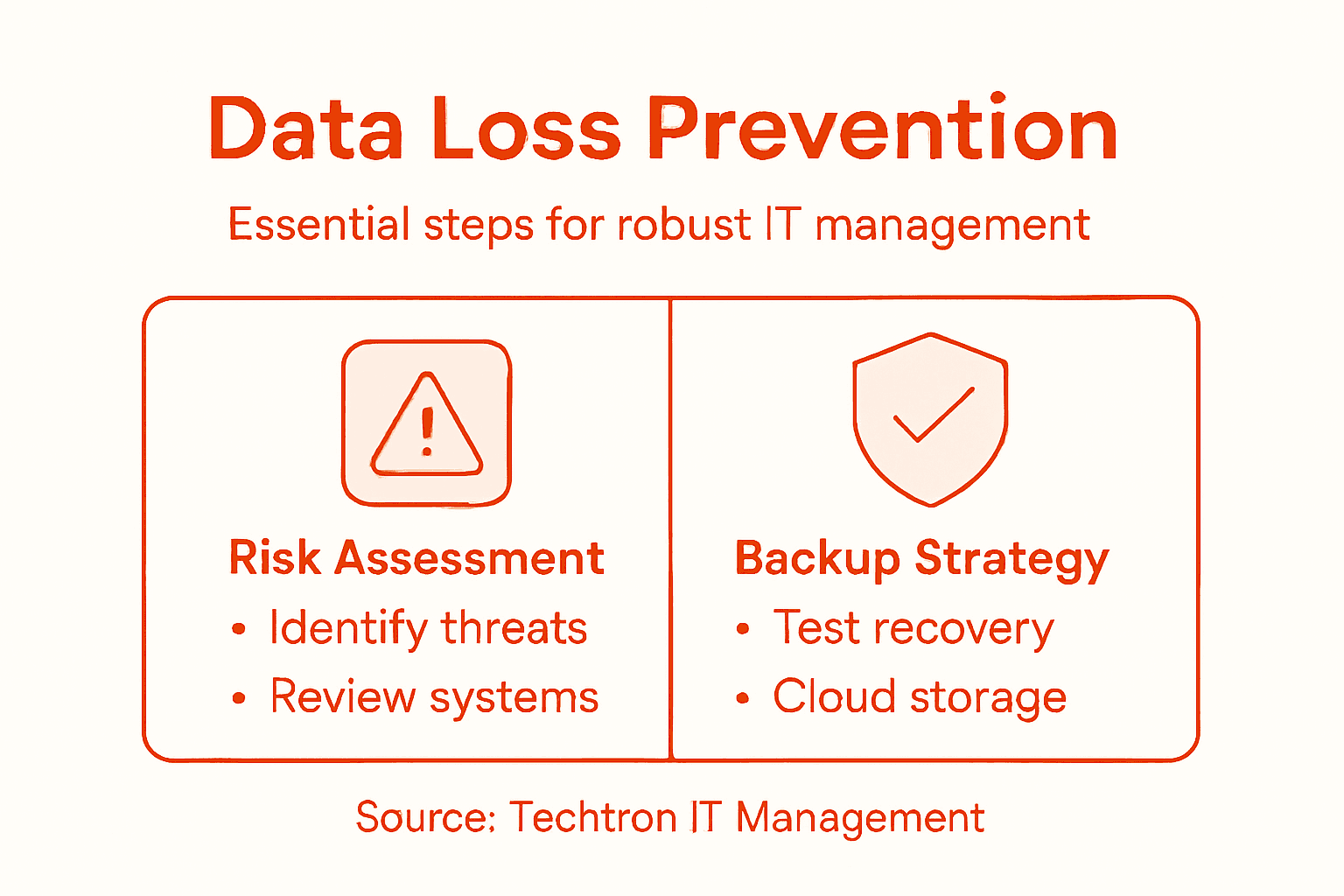
Data risk assessment forms the critical foundation of any robust IT management strategy. By systematically evaluating potential vulnerabilities, organisations can proactively defend against potential security breaches and operational disruptions.
To conduct a comprehensive data risk assessment, begin by mapping out your entire digital infrastructure. This involves creating a detailed inventory of all hardware, software, network systems, and data storage mechanisms. Pay special attention to key risk management strategies that are specific to South African regulatory environments.
Your assessment should cover multiple risk dimensions:
- Hardware vulnerabilities
- Software security gaps
- Network access points
- Third-party vendor dependencies
- User access management
- Compliance with local data protection regulations
The South African financial sector provides an excellent framework for risk assessment. Regulatory guidelines from financial authorities mandate continuous identification and monitoring of IT risks, including cybersecurity threats and operational disruptions.
Consider engaging professional cybersecurity experts who understand the nuanced technological landscape of South African businesses. They can provide sophisticated threat analysis and help develop targeted mitigation strategies.
A comprehensive data risk assessment is not a one-time event, but an ongoing process of continuous monitoring and adaptation.
Pro tip: Create a risk assessment schedule that includes quarterly comprehensive reviews and monthly quick audits to maintain up-to-date security insights.
Step 2: Implement robust backup and recovery solutions
Establishing a comprehensive backup and recovery strategy is crucial for protecting your organisation’s digital assets and ensuring business continuity. By implementing systematic backup protocols, you can safeguard against potential data loss and minimise operational disruptions.

Start by developing a multi-layered backup approach that covers different data storage mechanisms. Your backup strategy should include automated backup solutions that capture critical information across various platforms.
Key components of an effective backup and recovery solution include:
- Local backup systems
- Cloud-based backup repositories
- Offsite data storage options
- Redundant backup mechanisms
- Regular backup verification processes
- Quick recovery point objectives
The South African public sector’s experience highlights the critical importance of comprehensive backup procedures. Government IT systems management reports reveal significant risks associated with inadequate backup protocols, underscoring the need for rigorous data protection strategies.
Implement a tiered backup strategy that categorises data based on its criticality and recovery priority. This approach ensures that mission-critical information receives the highest level of protection and can be rapidly restored in case of an incident.
Effective backup solutions are not just about storage, but about creating a resilient system that can quickly restore operations during unexpected disruptions.
Pro tip: Conduct quarterly disaster recovery simulations to test your backup systems and identify potential vulnerabilities before they become critical issues.
Step 3: Enforce secure access and authentication policies
Securing your organisation’s digital access points is fundamental to protecting sensitive information and preventing unauthorized data breaches. By implementing robust authentication strategies, you can significantly reduce the risk of cybersecurity incidents and maintain strict control over digital resources.
Develop a comprehensive access management framework that incorporates rigorous user access controls tailored to your specific organisational requirements. The South African financial regulatory environment provides clear guidance on implementing sophisticated security protocols.
Key components of an effective authentication policy include:
- Multi-factor authentication
- Role-based access control
- Regular access rights audits
- Least privilege principles
- Comprehensive user identity verification
- Automated access monitoring systems
Secure access management guidelines from the South African Reserve Bank emphasize the critical importance of implementing dynamic and adaptive authentication mechanisms that balance security with operational efficiency.
Implement strong password management protocols that require complex credentials and mandate regular password rotation. Consider deploying advanced authentication technologies such as biometric verification or hardware security tokens for enhanced protection.
Authentication is not just about preventing unauthorized access, but creating a comprehensive security ecosystem that adapts to evolving digital threats.
Pro tip: Implement a continuous user access review process that automatically flags and investigates any unusual authentication patterns or potential security anomalies.
Below is a comparison of authentication strategies and backup tiers for optimal enterprise security:
| Strategy | Focus Area | Key Benefit |
|---|---|---|
| Multi-factor authentication | Access control | Reduces the risk of unauthorised access |
| Tiered backup management | Data protection | Prioritises mission-critical information |
| Biometric verification | User validation | Enhances identity assurance |
| Offsite backup tiers | Recovery ability | Allows fast recovery after disasters |
Step 4: Integrate proactive monitoring and alerts
Proactive monitoring represents the frontline defence in identifying and mitigating potential IT risks before they escalate into significant operational challenges. By implementing sophisticated real-time monitoring systems, you can create an intelligent early warning mechanism that protects your organisation’s digital infrastructure.
Design a comprehensive monitoring strategy that includes network performance tracking across all critical technology platforms. Focus on establishing automated alert mechanisms that provide immediate notifications about potential security incidents or system anomalies.
Key elements of an effective proactive monitoring framework include:
- Real-time system performance dashboards
- Automated anomaly detection algorithms
- Continuous network traffic analysis
- Predictive threat intelligence integration
- Customisable alert configuration
- Rapid incident response protocols
Government IT system audits highlight the critical importance of implementing robust monitoring mechanisms to prevent undetected vulnerabilities and potential data loss incidents.
Configure intelligent monitoring thresholds that can distinguish between routine system variations and genuine security threats. Leverage machine learning and artificial intelligence technologies to enhance your monitoring capabilities and reduce false-positive alerts.
Effective monitoring is not about collecting data, but about transforming raw information into actionable insights that protect your organisation.
Pro tip: Establish a centralised monitoring dashboard that provides a holistic view of your entire IT ecosystem, enabling faster decision-making and more efficient resource allocation.
Here’s how monitoring differs from recovery testing in IT risk management:
| Aspect | Proactive Monitoring | Recovery Testing |
|---|---|---|
| Main Goal | Detect issues early | Ensure rapid restoration |
| Approach | Continuous, real-time | Scheduled, scenario-based |
| Typical Tools | Dashboards, alerts, analytics | Simulation, validation scripts |
| Outcome | Prevention of disruptions | Proof of resilience and readiness |
Step 5: Verify and test data recovery readiness
Data recovery readiness is not a theoretical concept but a critical operational requirement that demands rigorous and systematic validation. Ensuring your organisation can rapidly restore critical systems during unexpected disruptions requires comprehensive and methodical testing approaches.
Develop a structured testing framework that includes comprehensive disaster recovery planning tailored to your specific technological infrastructure. This process involves simulating various potential failure scenarios to validate the effectiveness of your backup and recovery mechanisms.
Key components of a robust data recovery testing strategy include:
- Full system restoration simulations
- Partial system recovery scenarios
- Database integrity verification
- Network infrastructure failover tests
- Application-level recovery validation
- Cross-departmental communication protocols
Government IT system audits underscore the critical importance of regular and comprehensive testing to prevent potential data loss incidents and ensure operational continuity.
Implement systematic recovery validation protocols that go beyond theoretical documentation. Conduct quarterly full-scale recovery drills that stress-test your entire backup and restoration infrastructure, identifying potential weaknesses before they become critical failures.
Effective data recovery testing is not a single event, but a continuous process of validation, improvement, and adaptation.
Pro tip: Document and analyse every recovery test meticulously, treating each simulation as a learning opportunity to incrementally enhance your organisation’s resilience.
Strengthen Your IT Management to Prevent Costly Data Loss
Effective IT management is essential for businesses aiming to safeguard their digital assets against risks such as hardware vulnerabilities, network breaches, and compliance gaps mentioned in the article Preventing Data Loss with Effective IT Management. The challenge of maintaining continuous backup, secure access controls, and rigorous recovery testing can create overwhelming pressure. You need a partner who understands these unique demands and offers proactive, reliable solutions tailored for South African professional service firms.
At Techtron, we specialise in comprehensive IT management that aligns perfectly with the article’s emphasis on robust backup and recovery strategies, secure authentication policies, and real-time monitoring. Our managed IT services reduce your technical burden while maximising security and operational continuity with solutions including automated backup systems and user access management. Take control of your IT risks now before they impact your business stability. Visit Techtron today to explore how our expert support can transform your IT resilience and prevent costly data loss.
Frequently Asked Questions
How can I assess current data risks in my organisation?
Begin by creating a detailed inventory of your entire digital infrastructure, including hardware, software, and network systems. Map out potential vulnerabilities and schedule comprehensive reviews every quarter to keep your security insights up to date.
What are the key components of an effective backup and recovery solution?
An effective backup solution should include local and cloud-based backups, regular verification processes, and a tiered backup strategy that prioritises mission-critical data. Ensure to conduct quarterly disaster recovery simulations to test and strengthen your backup systems.
What authentication policies should I implement to secure my data?
Implement multi-factor authentication and role-based access control to regulate who can access sensitive information. Regularly audit access rights and enforce strong password management protocols to enhance security across your organisation.
How can proactive monitoring help prevent data loss?
Proactive monitoring allows you to identify and mitigate potential IT risks before they escalate. Set up real-time monitoring systems with automated alerts and establish intelligent monitoring thresholds to distinguish between routine system variations and security threats.
What steps are involved in verifying data recovery readiness?
Establish a structured testing framework that includes full and partial system restoration simulations, as well as network infrastructure failover tests. Conduct quarterly full-scale recovery drills and meticulously document the results to continuously improve your organisation’s data recovery strategies.
How often should I review and update my IT management strategies?
Regularly review your IT management strategies at least once every three months. Continuous monitoring and adaptation ensure that your organisation stays ahead of potential data risks and maintains optimal security measures.
Recommended
- 4 ways to protect your business from data loss | TECHTRON
- Why Data Backup Remains Important | TECHTRON
- Data Recovery and Backups for SMEs | TECHTRON
- 7 reasons why it’s crucial to back up your data | TECHTRON
- What Is Managed IT Services? Understanding The Basics – Stratgetic IT Consultants For Accountants