

Cyber audit guide for IT managers in 2026
TL;DR:
- Cyber audits evaluate an organization’s cybersecurity governance, risk management, controls, and defenses. They are now a regulatory requirement for mid-sized businesses, emphasizing governance over just technical measures. Regular audits, evidence collection, and risk quantification strengthen long-term security and executive decision-making.
A cyber audit is a structured evaluation of an organisation’s cybersecurity governance, risk management, controls, and technical defenses to identify vulnerabilities and improve resilience. For mid-sized South African businesses, this process is no longer optional. The IIA Cybersecurity Topical Requirement, effective february 5, 2026, requires public companies to formally document cyber governance audit processes for regulatory disclosures. That standard signals a broader shift: cybersecurity assessments are now a governance obligation, not just an IT task.
What is a cyber audit and why does it matter?
A cyber audit differs fundamentally from a penetration test. Penetration tests focus on exploiting vulnerabilities; cyber audits evaluate governance, risk management, controls, and operational processes across the entire organisation. That broader scope is what makes the IT security evaluation genuinely useful to decision-makers.

Without governance, technical controls offer no real defense assurance. Cybersecurity governance covers objectives, accountability structures, and board oversight. A cyber audit starts there, then works outward to technical systems and incident readiness.
For South African businesses, the stakes are concrete. California’s updated CCPA regulations, which many global-facing firms must track, mandate independent cybersecurity audit accountability beginning 2027, with preparation required in 2026. Local firms handling international clients face similar pressures from their own contractual and regulatory obligations.
How to prepare for an effective cyber audit
Audit readiness starts well before the audit itself. The most common failure point is treating preparation as a last-minute exercise. Continuous evidence collection, including logs, change records, approvals, and system documentation, prevents that scramble and produces stronger assurance.
Essential elements for audit readiness
Before scheduling an audit, confirm these are in place:
- Documented security objectives aligned to a recognised framework such as NIST CSF, ISO 27001, or CIS Controls
- Centralised audit data repository holding access logs, patch records, and policy approvals
- Defined accountability structures showing who owns each control domain
- Up-to-date policy documentation covering acceptable use, incident response, and data classification
- Risk register with current threat assessments and control gaps noted
| Audit element | Responsible party | Purpose |
|---|---|---|
| Audit management software | IT manager | Tracks findings, tasks, and deadlines |
| System and access logs | IT operations | Provides evidence of control operation |
| Policy documentation | Compliance or legal | Confirms governance framework exists |
| Risk framework (NIST, ISO 27001) | IT manager or CISO | Scopes the audit and benchmarks controls |
| Board oversight records | Executive team | Demonstrates governance maturity |
Pro Tip: Start a shared audit evidence folder at the beginning of each financial year. Add logs, approvals, and policy updates as they happen. By audit time, your evidence pack is already 80% complete.
How to conduct a cyber audit step by step
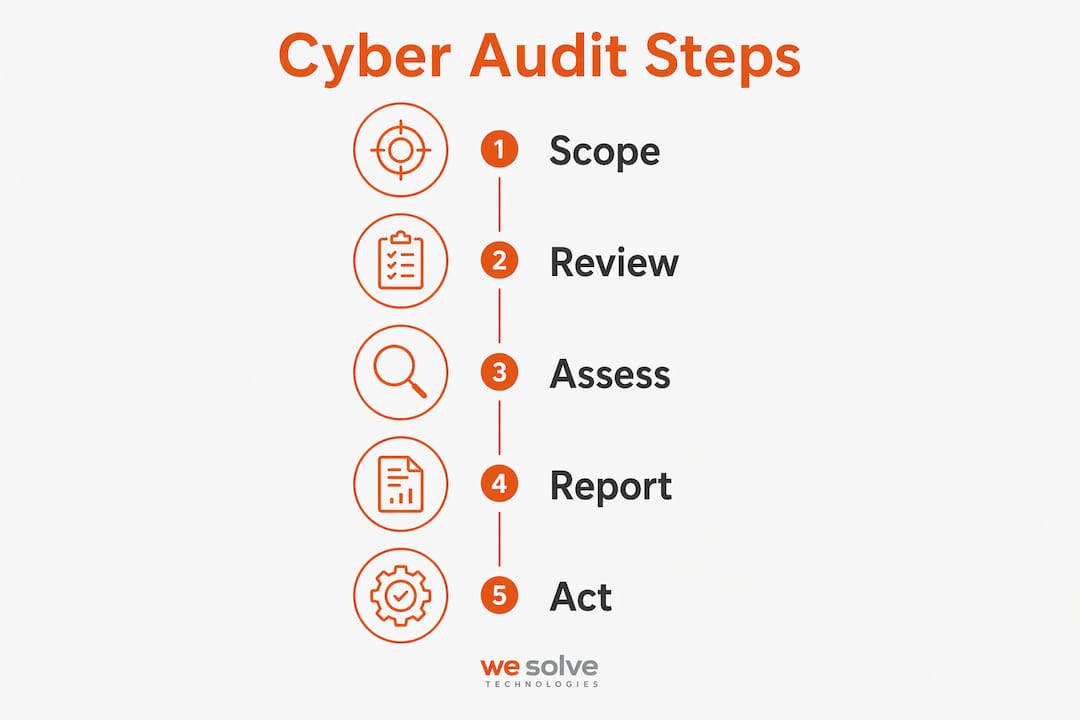
A well-run data security audit follows a clear sequence. Skipping steps, particularly scoping and governance review, produces findings that are hard to act on.
-
Define scope and objectives. Identify which systems, processes, and data are in scope. Align the scope to a framework such as NIST CSF or ISO 27001. Document what the audit will and will not cover.
-
Review governance and accountability. Assess whether the organisation has documented security objectives, board-level oversight, and clear ownership of controls. Without mature governance, technical findings lack context and remediation stalls.
-
Collect and analyse evidence. Gather access logs, patch histories, incident records, and policy documents. Cross-reference evidence against the chosen framework to identify gaps.
-
Evaluate technical controls. Test firewall configurations, access controls, encryption standards, and endpoint protection. Use your cybersecurity audit checklist to avoid missing critical control areas.
-
Assess incident readiness. Review the incident response plan, test whether staff know their roles, and check that contact lists and escalation paths are current.
-
Quantify risk using the FAIR model. Most executives struggle to quantify cyber risk in financial terms. The FAIR (Factor Analysis of Information Risk) model translates audit findings into rand-value exposure, which makes budget decisions far easier to justify.
-
Report and assign remediation. Produce a findings report with each gap rated by severity and financial impact. Assign an owner and deadline to every remediation task.
| Audit phase | Key output |
|---|---|
| Scoping | Defined audit boundary and framework alignment |
| Governance review | Accountability map and board oversight assessment |
| Evidence collection | Documented control operation across all domains |
| Technical evaluation | Control gap list with severity ratings |
| Risk quantification | Financial exposure estimate per finding |
| Remediation planning | Task list with owners and deadlines |
Pro Tip: Schedule your cyber audit at least annually. Higher-risk organisations or those undergoing major IT changes should audit more frequently. Quarterly reviews of high-severity findings keep remediation on track between full audits.
Common pitfalls and how to avoid them
The biggest mistake mid-sized businesses make is treating a cyber audit as a once-a-year compliance checkbox. Moving from static annual events to continuous audit readiness produces stronger assurance and far less stress when auditors arrive.
A narrow technical focus is the second major pitfall. Auditing only firewalls and endpoints while ignoring governance, policy, and human factors misses the controls most likely to fail in a real incident. A thorough IT security evaluation covers people, processes, and technology equally.
Cross-functional coordination is consistently underestimated. Finance, HR, legal, and operations all hold data and run processes that fall within audit scope. Engaging those teams early prevents last-minute evidence gaps and builds organisation-wide security awareness.
Pro Tip: Assign a single internal audit coordinator who owns the evidence repository and stakeholder communication. That one role eliminates most coordination failures.
“Audit reports should serve as actionable battle plans with assigned remediation tasks and accountability to be meaningful.” — Hyperproof cybersecurity audit best practices
Translating findings into a battle plan means converting each recommendation into a specific policy update or control change, naming an owner, and setting a deadline. Reports that sit unread in a shared drive deliver zero security improvement.
How to use audit results to strengthen your security posture
Audit findings are most valuable when they feed directly into budget decisions and security strategy. Mapping findings to the FAIR model gives executives a financial view of each gap, which makes it possible to compare the cost of remediation against the cost of a breach.
Board-level oversight is not optional. Effective cybersecurity audits depend on mature governance, including board involvement and clear accountability. Present audit results to the board with financial exposure figures, not just technical severity ratings. That framing drives faster decisions and appropriate budget allocation.
Building an audit-ready culture year-round is the most sustainable outcome. Teams that gather evidence consistently throughout the year, rather than scrambling before each audit, develop stronger security habits overall. Review your cybersecurity best practices regularly and update controls as the threat environment changes.
| Audit result action | Benefit |
|---|---|
| Assign owners to each finding | Ensures accountability and tracks progress |
| Quantify risk in financial terms | Supports budget and board decisions |
| Schedule quarterly remediation reviews | Keeps gaps from growing between audits |
| Update policies based on findings | Closes governance gaps identified in the audit |
| Report to board with financial framing | Drives executive engagement and resource allocation |
Key takeaways
A cyber audit delivers lasting value only when governance, risk quantification, and continuous evidence collection are treated as year-round disciplines, not annual events.
| Point | Details |
|---|---|
| Governance comes first | Without documented objectives and board oversight, technical findings lack context and remediation stalls. |
| Continuous evidence collection | Maintain logs, approvals, and policy records throughout the year to avoid last-minute scrambles. |
| Quantify risk financially | Use the FAIR model to translate audit findings into rand-value exposure for better budget decisions. |
| Audit findings need owners | Convert every finding into a task with a named owner and deadline to close gaps systematically. |
| Annual audits are the minimum | Higher-risk organisations and those undergoing IT changes should audit more frequently than once a year. |
Why cyber audits must go beyond compliance
Working with IT managers across South African mid-sized businesses, I see the same pattern repeatedly. The audit gets done, the report gets filed, and six months later the same gaps appear in the next assessment. The problem is not the audit itself. The problem is that most organisations treat the report as the finish line rather than the starting point.
The shift that actually changes security outcomes is treating the audit as a governance tool, not a compliance exercise. When the board sees financial exposure figures rather than technical severity ratings, conversations about cybersecurity investment change completely. Executives who previously saw security spending as a cost centre start treating it as risk management.
My strongest advice for IT managers is this: own the narrative. You understand the cyber risk assessment process better than anyone in the room. Translate your findings into business language, assign clear ownership, and follow up relentlessly. That is what separates organisations that improve from those that repeat the same audit findings year after year.
— Steven
How Techtron supports your cyber audit process
Techtron works with mid-sized South African businesses to prepare for, execute, and act on cybersecurity assessments. From building governance frameworks to maintaining continuous evidence repositories, Techtron’s managed IT and cybersecurity services give your team the structure and expertise to turn audit findings into real security improvements. Whether you need support preparing for your first formal audit or want to build year-round audit readiness into your IT operations, Techtron provides the hands-on guidance your business needs. Contact Techtron to discuss how a co-managed IT approach can support your security and compliance goals.
FAQ
What is a cyber audit?
A cyber audit is a structured evaluation of an organisation’s governance, risk management, controls, and technical defenses. It differs from a penetration test by assessing overall control effectiveness rather than exploiting specific vulnerabilities.
How often should a cyber audit be conducted?
Security audits should be conducted at least annually. Organisations with high-risk profiles or significant IT changes benefit from more frequent assessments.
What frameworks guide a cyber audit?
The most widely used frameworks are NIST CSF, ISO 27001, and CIS Controls. These provide a structured benchmark against which audit findings are measured and prioritised.
How do audit findings support business decisions?
Mapping findings to the FAIR risk model translates technical gaps into financial exposure figures. That framing helps executives compare remediation costs against potential breach costs and allocate budget accordingly.
What regulations require cyber audits in 2026?
The IIA Cybersecurity Topical Requirement, effective february 5, 2026, requires US public companies to document cyber governance audit processes. California’s CCPA regulations phase in independent cybersecurity audit accountability from 2027, with preparation required in 2026.