

Identity Access Management Explained – Key Benefits for SA Firms
Pressure mounts when sensitive data is constantly at risk for South African businesses. Protecting client information and meeting compliance like POPIA is not optional for IT decision makers in engineering and financial services sectors. Balancing security with smooth user experiences, Identity and Access Management solutions help you manage who has access to crucial digital assets, enforce strict permissions, and automate onboarding, providing peace of mind without adding needless complexity.
Key Takeaways
| Point | Details |
|---|---|
| Importance of IAM | Identity and Access Management is vital for securing digital assets in South African organisations by controlling user access and preventing unauthorised entry. |
| Core Components | Key features include User Authentication, Access Control, and Single Sign-On, which work collaboratively to enhance security and user management. |
| Legal Compliance | Organisations must comply with the Protection of Personal Information Act, ensuring data is protected and access is limited to authorised personnel. |
| Risks and Integration | Common pitfalls in IAM integration, such as weak authentication and insufficient user training, can lead to significant financial and reputational risks. |
Defining identity access management solutions
Identity and Access Management (IAM) represents a critical cybersecurity strategy for protecting digital resources in modern South African organisations. Identity and access management processes are comprehensive systems designed to control and manage user permissions across technological environments.
At its core, IAM encompasses several key components that work together to secure organisational digital assets:
- User Authentication: Verifying the identity of individuals requesting system access
- Access Control: Determining specific permissions for authenticated users
- User Lifecycle Management: Managing user accounts from creation to deletion
- Single Sign-On (SSO): Enabling access across multiple systems with one credential set
The primary goal of IAM solutions is to ensure that the right individuals have appropriate access to specific technological resources while simultaneously preventing unauthorized entry. This approach helps organisations maintain robust security protocols, reduce potential breaches, and streamline user management processes.

Understanding IAM requires recognising its role in creating a secure digital ecosystem. By implementing sophisticated access management strategies, businesses can protect sensitive information, maintain regulatory compliance, and create efficient technological workflows that balance security with user convenience.
Pro tip: Conduct regular access privilege audits to identify and remove unnecessary user permissions that could potentially compromise your organisational security.
Major types and core functionalities
In the South African cybersecurity landscape, identity management solutions offer diverse capabilities designed to protect organisational digital infrastructure. These solutions encompass multiple sophisticated approaches to managing user access and protecting sensitive technological resources.
The core functionalities of IAM systems typically include:
- User Provisioning: Automated management of user account creation and lifecycle
- Single Sign-On (SSO): Enabling seamless access across multiple platforms
- Multi-Factor Authentication (MFA): Adding additional security verification layers
- Role-Based Access Control (RBAC): Assigning system permissions based on user roles
- Compliance Logging: Generating comprehensive audit trails for security monitoring
South African organisations can leverage several major IAM solution types to enhance their cybersecurity posture. These include Privileged Access Management (PAM), which provides granular control over high-level administrative accounts, and Identity Governance and Administration (IGA), which enables comprehensive user access monitoring and policy enforcement.
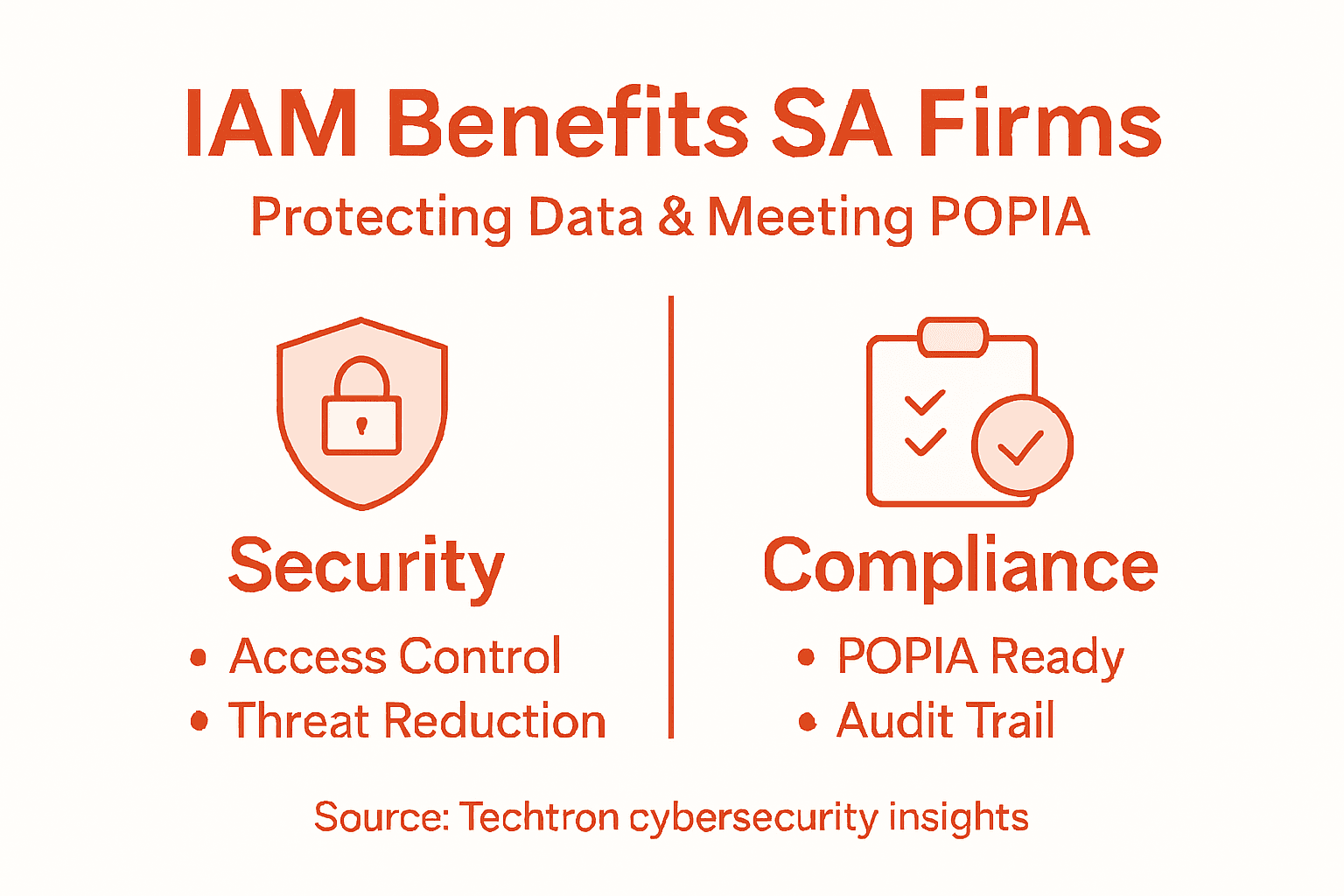
Advanced authentication technologies like biometric and passwordless authentication are becoming increasingly prevalent, offering more secure and user-friendly access methods. These innovations help organisations meet stringent regulatory requirements such as the Protection of Personal Information Act (POPIA) while maintaining robust security protocols.
Here is a quick summary of major IAM solution types and their main business benefits:
| IAM Solution Type | Main Focus | Key Business Benefit |
|---|---|---|
| Privileged Access Management (PAM) | Controls admin account access | Minimises risk from insider threats |
| Identity Governance and Administration (IGA) | Monitors and enforces policies | Ensures regulatory compliance |
| Biometric Authentication | Uses physical traits for access | Increases convenience and security |
| Passwordless Authentication | Eliminates traditional passwords | Reduces phishing and credential theft |
Pro tip: Regularly review and update user access permissions to ensure alignment with current organisational roles and minimise potential security vulnerabilities.
How IAM works for business security
Modern businesses require sophisticated mechanisms to protect their digital assets, and identity access management verification represents a critical cybersecurity strategy. The fundamental approach involves comprehensive identity authentication and precise access control mechanisms that safeguard organisational resources across various technological environments.
The IAM security process typically involves several key stages:
- Identity Verification: Confirming user credentials through multiple authentication methods
- Permission Mapping: Assigning specific access levels based on user roles
- Continuous Monitoring: Tracking user activities and detecting potential security anomalies
- Dynamic Access Control: Adjusting permissions in real-time based on contextual factors
- Compliance Tracking: Generating detailed logs for regulatory and internal audit purposes
South African organisations particularly benefit from IAM systems that support hybrid work environments, enabling secure access for employees working both on-site and remotely. By implementing robust multifactor authentication and role-based access controls, businesses can significantly reduce the risk of unauthorized system penetration and potential data breaches.
The technological infrastructure supporting IAM involves sophisticated algorithms and security protocols that continuously validate user identities, assess risk levels, and enforce granular access permissions. This dynamic approach ensures that each user receives precisely the level of system access required for their specific organisational responsibilities, while maintaining a comprehensive security perimeter.
Pro tip: Implement a regular access review process that systematically validates and updates user permissions to maintain optimal security configurations.
Legal obligations and compliance in South Africa
South African organisations must navigate complex regulatory landscapes, with Protection of Personal Information Act compliance representing a critical legal requirement for businesses handling personal data. The legislative framework demands rigorous approaches to data protection and access management that go far beyond simple technological implementations.
Key legal compliance requirements for South African businesses include:
- Data Minimisation: Collecting only essential personal information
- Purpose Limitation: Using data exclusively for specified, legitimate purposes
- Access Control: Restricting data access to authorized personnel
- Security Safeguards: Implementing robust technical and organisational protections
- Consent Management: Obtaining explicit permission for data processing
The Protection of Personal Information Act (POPIA) establishes stringent guidelines for organisations, with potential consequences that extend well beyond financial penalties. Non-compliance can result in administrative fines up to ZAR 10 million, potential civil or criminal proceedings, and significant reputational damage that could permanently impact business credibility.
The Information Regulator plays a crucial role in enforcing these regulations, ensuring that South African businesses maintain comprehensive identity and access management strategies that align with legal requirements. By proactively implementing sophisticated IAM solutions, organisations can demonstrate their commitment to data protection and build trust with customers, partners, and regulatory bodies.
Pro tip: Conduct regular comprehensive audits of your data management processes to ensure ongoing compliance with POPIA requirements and identify potential vulnerabilities.
Common risks, costs and integration mistakes
South African organisations face significant challenges when implementing Identity Access Management (IAM) systems, with digital ID system integration risks presenting complex cybersecurity vulnerabilities. Understanding these potential pitfalls is crucial for developing robust and secure technological infrastructures.
Key risks and potential integration mistakes include:
- Weak Authentication Mechanisms: Relying on single-factor authentication
- Inadequate Access Controls: Failing to implement granular permission settings
- Credential Sharing: Permitting multiple users to share login credentials
- Insufficient User Training: Neglecting cybersecurity awareness programs
- Poor Password Management: Using default or easily guessable passwords
The financial implications of IAM implementation failures can be substantial. Data breaches resulting from poor identity management can lead to significant costs, including regulatory fines, legal expenses, reputational damage, and potential business disruption. South African enterprises might face penalties up to ZAR 10 million under POPIA regulations, not to mention the potential loss of customer trust and competitive advantage.
Successful IAM integration requires a holistic approach that considers technological, human, and regulatory factors. Organisations must develop comprehensive strategies that balance security requirements with user experience, implement robust authentication protocols, and maintain ongoing monitoring and review processes to mitigate potential vulnerabilities.
The table below compares common IAM integration pitfalls with recommended solutions:
| Integration Mistake | Main Risk Exposed | Recommended Remedy |
|---|---|---|
| Single-factor authentication | Easy unauthorised access | Implement multifactor authentication |
| Poor password management | Credential compromise | Enforce strong password policies |
| Insufficient user training | Human error | Regular cybersecurity education |
| Inadequate access controls | Data leakage | Use role-based access settings |
| Credential sharing | Loss of accountability | Assign unique user identities |
Pro tip: Conduct regular comprehensive security audits and penetration testing to identify and address potential IAM vulnerabilities before they can be exploited.
Strengthen Your Business Security with Expert Identity Access Management Solutions
South African businesses face increasing challenges securing sensitive digital assets while meeting strict Protection of Personal Information Act compliance requirements. The article highlights the critical need for robust identity verification, precise access controls, and ongoing monitoring to minimise risks like unauthorised access and data breaches. For professional service firms eager to protect their infrastructure without overwhelming internal teams, adopting advanced IAM strategies is essential.
At Techtron, we specialise in delivering tailored managed IT services that align seamlessly with these IAM principles. Our offerings include comprehensive cybersecurity, proactive network security, and cloud solutions designed to safeguard your digital ecosystem with strong authentication methods and role-based access controls. Let us help you reduce security vulnerabilities while ensuring operational continuity and regulatory compliance.
Discover how partnering with us can transform your identity and access management approach. Take action today and secure your organisation’s future with expert IT support from Techtron. Contact us now to customise a solution that fits your business needs and scale.
Frequently Asked Questions
What is Identity Access Management (IAM)?
Identity Access Management (IAM) is a cybersecurity strategy that controls and manages user permissions across technological environments to ensure that the right individuals have appropriate access to digital resources while preventing unauthorized access.
What are the key components of IAM solutions?
Key components of IAM solutions include user authentication, access control, user lifecycle management, and single sign-on (SSO), all of which work together to secure an organization’s digital assets.
How do IAM systems enhance business security?
IAM systems enhance business security by implementing robust identity verification and precise access control mechanisms that continuously monitor user actions, adjust permissions in real-time, and ensure compliance with security protocols and regulations.
What are the main legal compliance requirements for organizations using IAM?
Organizations using IAM must comply with legal requirements such as data minimization, purpose limitation, access control, and the implementation of security safeguards, as outlined in regulations like the Protection of Personal Information Act (POPIA).